Sunday, August 31, 2014

Valcour Island and the Lessons of History

It is easy to see Valcour Island from the boat launch at Peru, New York, and from the campus of Clinton County Community College at Bluff's Point, but not from the vicinity of the New York State Marker along Route 9 that purports to identify the area of the action.  There is a conference center there (private property).  One wold think that such an important battle would not only not be so generally ignored in discussions of the war for the lay person, but would also have a small dedicated parking and viewing area by the roadside.

Anyway, here's a view of the strait near the sign that shows the vicinity of the battle.
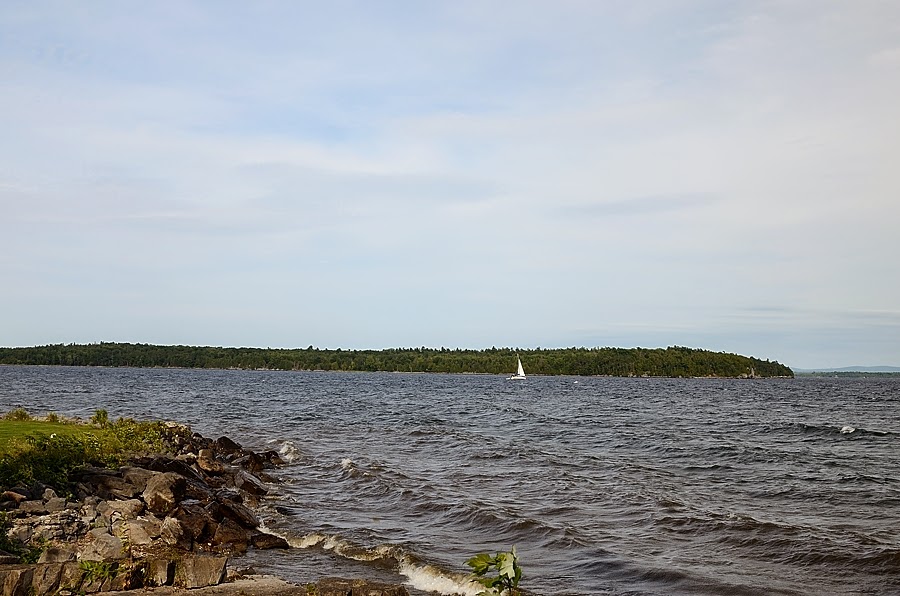

There are those who credit Benedict Arnold with creating and commanding America's first navy.  It was here, in the straight between the New York mainland (shown in foreground) and Valcour Island (showing the island to its southern tip) that, on October 11, 1776, Arnold stopped the pursuit of Guy Carleton, commander-in-chief of the British forces in Canada, following Arnold's withdrawal from the siege of Quebec in spring 1776.

The only other plaque I found apart from the one by Route 9 was at Bluff's Point.  We should always recall the words of George Santayana that "Those who cannot remember the past are condemned to repeat it," although Edmund Burke far more contemporaneous to the Revolution, also reportedly said, “Those who don't know history are doomed to repeat it.” The war might well have been crushed before it began but for Arnold's determined and heroic stand in these waters, yet you could not tell it from the minimal coverage here. 

Sunday, August 17, 2014

The Revolution and Canada I

Among the histories of the Revolutionary War I have read, discussion of Canada is limited generally to the attacks on Montreal and Quebec, and the subsequent battles during the withdrawal of the Americans.  What may not be readily understood is the more global impact of the war on other regions in Canada--such as distant Newfoundland.

Here is the site of Fort Townshend in St. John's.


We can see in the middle distance the Southern Hills that forms part of the Narrows leading into the harbor.  Fort Townshend was built between 1773 and 1779 and headquartered the British garrison in Newfoundland during the Revolution.  

The Heritage Website of Newfoundland and Labrador notes the deleterious effect on the Newfoundland economy as trade was disrupted through political acts and the sea routes subjected to the effect of the war, privateers and naval action.  When Spain joined the American-French side, Newfoundland lost another market.  Nonetheless, Newfoundlanders did not sympathize with or join the American cause.  

IN 1778 the Newfoundland Volunteers was organized and constructed Fort Townshend; two years later, the Newfoundland Regiment was formed with 300 men to defend Newfoundland, under command of Captain Robert Pringle.

Today, Newfoundland is a 2 1/3 hour flight from Newark, New Jersey.  Despite that remoteness from the epicenter of the American Revolution, the economic and political effects of the war reverberated to the furthest reaches of colonized North America.


Tuesday, August 12, 2014

Noddle's Island Revisited

The plaque at this forlorn site tells us that on May 27, 1775 nearby was fought the Battle of Chelsea Creek.  It is also known as the Battle of Noddle's Island, on which now sits Logan Airport.  Colonel John Stark, who later proved pivotal at Bunker Hill and Bennington, according to the sign, "successfully engaged the British regulars in driving livestock from Hog and Noddle Islands."


We see Chelsea Creek (shown on certain maps as Chelsea River).  The plaque, at the far right of the image, tells us we are in the area of the engagement by Stark, and calls this "the Colonies' first victory of the American Revolution," including affording it the status of the first naval engagement of the war.

 A minor escapade involving foraging and the successful downing of one vessel continues in the public imagination as a military victory.


Friday, July 25, 2014

The Fractured United States

     The Battle of King Mountain, fought October 7, 1780, was one of the key battles of the Revolution, in that it severely damaged the ability of Cornwallis to execute upon his strategy to secure the Carolinas.  He had maintained confidence that he could still raise support from Loyalist elements.  He was wrong.  Here is a view of the battle monument on top of the "mountain."


     The battle was a bitter and brutal affair in South Carolina. Among its distinguishing features was that it was a battle fought between Americans--Loyalists and Patriots. The only "regular army" officer was Major Patrick Ferguson, leader of the Loyalist forces. 

     Currently, we are in the midst of another civil war, being fought in the media and in the voting booths.  Without physical casualties, it is nonetheless an exceedingly destructive war.  It has become a fight to the death.  There is no political discourse.  There are positions.  There are no arguments.  There is shoutdown and protest.  What we were in 1780 we are now in 2014.  People should go to King's Mountain and think about things.


Friday, July 4, 2014

The Battle of Wyoming (Wilkes-Barre)

The Battle of Wyoming on July 3, 1778  exemplified the brutality of the war and the involvement of Native Americans in the conflict.  A string of American forts along the Susquehanna River served the settlers in the Wyoming Valley, but became the subject of bitter action following the British defeats at Oriskany and Fort Stanwix in 1777.  Loyalists, British regulars and Mohawk, Onondaga, Cayuga, Oneida, Tuscarora and Seneca warriors, in a 700-man force led by Connecticut native Colonel John Butler raided the valley. Colonel Nathan Denison and Colonel Zebulon Butler commanded the Americans.   A combined British and Native American force defeated the Americans.

On July 4, the British demanded surrender of Forty Fort.  Initially signing terms of surrender, Denison later violated them and returned to fighting, only to lose.  Among the legacies of the battle was the rage that helped fuel General John Sullivan's campaign of devastation of Indian villages in the region in 1779.  Here is the scene today, of Forty Fort, lost on this day.


Saturday, June 28, 2014

Battle of Monmouth Anniversary

Today, June 28, 2014, marks the 236th anniversary of the Battle of Monmouth, in New Jersey.  I have noted Monmouth in a couple of prior posts.  Today we look at the spot, marked by this sign, on Perrine Hill where General George Washington rallied and reformed Continental forces in view of General Charles Lee's retreat.


General Henry Clinton was moving the British forces from Philadelphia to Sandy Point to depart for New York.  Washington paralleled his movements to the north across New Jersey, and sought what he hoped would be a dispositive encounter with Clinton.  They came together at Monmouth.  A long battle, it resulted in the Americans retaining the field and Clinton continuing his withdrawal--in short, a draw, though often hailed as an American victory.

Putting all that aside, this is my favorite spot on the battlefield, because we are standing in the place where Washington took charge and regained control of the troop.  We can see him on his horse moving back and forth here, and we can see what he saw as he looked out over the battlefield.  It is one of those places that remains close to how it was then, and transports us across time to see and feel (and, on a hot day like today, especially) gain a sense of place.

Sunday, June 8, 2014

Place, Things and Gaspee Point

I have focused often in this blog on the tangible pull of place, and the emotions and associations we make when physically standing on the site of an historic event.  Sometimes it is an artifact in a removed location that can have a comparable, if not the same, effect.

The Tribune Building in Chicago is a well-recognized Gothic structure.  At ground level, the building integrates stones, bricks and other components of famous sites.  On a recent visit, I noticed this:


Narragansett Bay, Rhode Island was the site of an attack on a British customs ship on June 10, 1772 as it was seeking to enforce the unpopular British customs laws with regard to the packet boat Hannah.  After the Gaspee ran aground.  The Gaspee's captain, Lieutenant William Dudingston, was wounded and captured.  For William R. Staples' 1845 account titled Documentary History of the Destruction of the Gaspee, click here.

So while it is not the same as standing on the bank of Narragansett Bay and imagining the scene unfolding, nonetheless, the observant Chicagoan passing by can touch this rock and have a "one step removed" experience from this critical event that became part of the mosaic of the Revolutionary War.