Showing posts with label history. Show all posts

Sunday, February 14, 2016

Colonel John Eager Howard

As much as I read and have read about the American Revolution, I am always struck by finding not only reference to, but statuary about, American military leaders below the rank of general in the war that barely penetrate the awareness of the contemporary American and yet were critical to the outcome of that war.  One example is Colonel John Eager Howard, perhaps most well known in Maryland but whose contributions were vastly important to that effort.  His equestrian statue is in the Mount Vernon Place in Baltimore, in the same park as the Washington Monument.

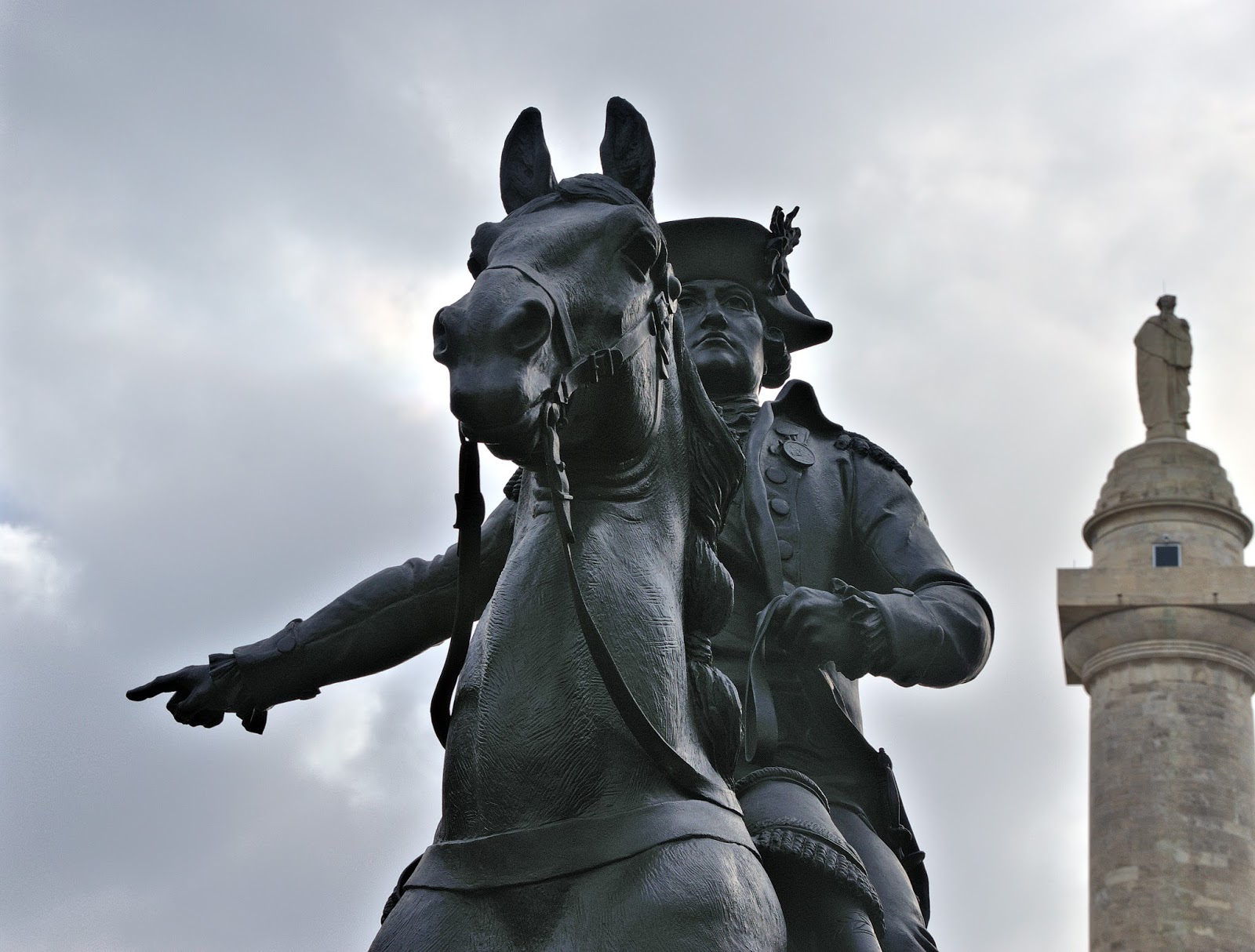
Born in Maryland, he saw action at White Plains as a captain, Germantown as a major, and at Camden, Cowpens, Guilford Court House, Hobkirk's Hill, Ninety Six and Eutaw Springs, holding the rank of Lieutenant Colonel.  He was wounded at Eutaw Springs and unable to fight afterwards; following the war, he served as Maryland's governor from 1788-1791, and in the United States Senate from 1796 through 1803.  His decisive bayonet charge at Cowpens was described by the commanding general, Daniel Morgan in this way: "[Howard's attack] was done with such address that the enemy fled with the utmost precipitation…. We pushed our advantages so effectually, that they never had an opportunity of rallying." As testament to his character and modesty, he not only declined President Washington's offer of Secretary of War, but also a commission as brigadier general in anticipation of war with France in 1798.  He married Peggy Oswald Chew, daughter of the Chief Justice of the Pennsylvania Supreme Court; the Chew house was at the center of the fighting in Germantown.

Resources:

http://www.nps.gov/cowp/learn/historyculture/johneagerhoward.htm

http://bioguide.congress.gov/scripts/biodisplay.pl?index=H000841

http://msa.maryland.gov/megafile/msa/speccol/sc3500/sc3520/000600/000692/html/692bio2.html


Monday, September 28, 2015

Siege of Charleston 1780

In the spring of 1780 through Guilford Courthouse in spring 1781, General Cornwallis' objective was to destroy the American army in the South, and the American plan was to harry the British, distract and essentially bleed them to death and, if possible, engage them decisively.  The British began well here, in Charleston, but their numbers would diminish through attrition whereas the Americans had seemingly endless men from which to draw.  Matters were not helped by Clinton's take it or leave it declaration on his departure from South Carolina for New York, pushing otherwise neutral persons as much towards the American as the British side, and escalating the bloody civil war in South Carolina.

Having failed early in the war to take Charleston under General Clinton, his second effort was successful.  The British fleet and troops arrived on February 10, 1780.  Together with and Lord Rawdon, he commanded 14,000 men and 90 ships.  General Benjamin Lincoln commanded 5,000 men.  Following a siege of about six weeks, Lincoln surrendered.  Here is Marion Square, where Lincoln surrendered.


The plaque tells us: "The British capture of Charleston in May 1780 was one of the worst defeats of the Revolution.  On March 30-31 Gen. Henry Clinton's British, Hessian, and Loyalist force crossed the Ashley River north of Charleston.  On April 1, Clinton advanced against the American defenses near this site, held by Gen. Benjamin Lincoln's Continentals and militia.  The 42-day siege would be the longest of the war. As Gen. Charles Cornwallis closed off Lincoln's escape routes on the Cooper River, Clinton advanced his siege lines and bombarded Charleston.  On May 12, 1780, in front of the American works near this spot, Lincoln surrendered the city and his force of 6,000 men, after what one British officer called "a gallant defense." The British occupied Charleston for more than 2 1/2 years, evacuating Dec. 14, 1782." Astute observers will recall that Yorktown was taken on  October 19, 1781, so for over a year, the British remained in control of the city.

People often think of Yorktown as the end of the war.  Cornwallis surrendered 8,000 soldiers.  Recall that the Americans surrendered some 2,800 soldiers at Fort Washington, New York, early in the war.  In Charleston, we are struck by just how little traditional military victories actually mattered in the end to the political solution.

Saturday, July 4, 2015

Thoughts on July 4

It seems the United States is becoming an increasingly neurotic society.  Every day some phrase or historical fact is under challenge as offensive to someone or another.  Read histories of the Revolutionary era, and see how "political correctness" is not new.  Loyalists and Patriots were, in numerous instances, brutal to each other.  The rhetoric went deep.  Still, I don't find it comparable to today, where one person writes a column and it is instantly on line, picked up and rallied around.  The counters may begin, but both sides seem to break along pre-disposition of viewpoint.  We are not left with any kind of rational discussion, let along debate.  That is because rational discussion is not a goal.  Hypocrisy of position in many instances exist, with a side taking one position that contradicts another in a different, but analogous context.  That doesn't matter any more.  All that matters is power, and beating down the other side.  Aggressive discourse is fine as long as it is meaningful and not purely destructive for its own sake.

What is disturbing is the degradation of any kind of sense of what it means to be an American.  This is not a call for knee-jerk flag-waving o the one hand, or the tear-it-down attitude on the other.  It just seems that few are interested in being an American in the same way they seek to be a Nationality-American or even just Nationality.

As Kurt Vonnegut wrote, "so it goes."

To participate in July 4, I usually go to the Princeton battlefield where a corps of reenactors demonstrate rifle and cannon firing.  It's a time for personal reflection, and while of course Princeton was not fought in July (but January), being there helps focus attention.  Note the touches of yellow flame in both rifle and cannon firing.


Thursday, December 25, 2014

Washington's Crossing 2014

I attended the annual reenactment of the 238th anniversary of General George Washington' Christmas Day crossing of the Delaware River, which preceded the 9 mile march south to Trenton and the victory over the Hessian garrison there.  Here is one image of one of the Durham boats being ferried across, filled with soldiers, and oared by the Colonel John Glover's Marbleheaders (in the red caps).


The narrator's concluding remarks stated that with the surrender of Cornwallis at Yorktown in 1781, the war ended in 1781.  This, of course, was not quite correct; the war continued until 1783 and Washington remained concerned that it might still be lost.  People who think the entire British army surrendered at Yorktown forget that New York, Charleston and Savannah were still occupied by significant numbers of British troops.  While the British loss at Yorktown caused the downfall of the North government and seriously hurt the British army, both sides had lost significant armies to surrender earlier in the war--the Americans at Forth Washington (New York) and at Charleston, and the British at Saratoga.  I do not raise all this to quibble as such; Yorktown was a decisive victory and led to the political will on the British side towards peace.  But the headline style way that history is presented, and the less than superficial understanding of Americans, is problematic, even in casual contexts.  These things have a way of sticking.

The reenactors deserve great credit for making history accessible and visible.  Still, there remains no substitute for presentation of history with integrity and attention to facts.  I saw a trailer playing in the movie theater this week that highlighted the History Channel's forthcoming series that basically casts Revolutionary leaders as moving from rogues to rebels to heroes.  Perhaps good marketing strategy, but this constant recasting of historical figures to make them fit contemporary "understandings" or notions of "narrative" and "political correctness" is disturbing.  A photographer is always safest returning to the negative; when they work off prints they are working off edited information.  The more we move from fact to narrative, the more we lose history.  Like a jpeg file that ultimately loses information if it is opened too many times, so, too, does our understanding dissipate if we try to "retell" what happened on the basis of preset dispositions.


Saturday, June 28, 2014

Battle of Monmouth Anniversary

Today, June 28, 2014, marks the 236th anniversary of the Battle of Monmouth, in New Jersey.  I have noted Monmouth in a couple of prior posts.  Today we look at the spot, marked by this sign, on Perrine Hill where General George Washington rallied and reformed Continental forces in view of General Charles Lee's retreat.


General Henry Clinton was moving the British forces from Philadelphia to Sandy Point to depart for New York.  Washington paralleled his movements to the north across New Jersey, and sought what he hoped would be a dispositive encounter with Clinton.  They came together at Monmouth.  A long battle, it resulted in the Americans retaining the field and Clinton continuing his withdrawal--in short, a draw, though often hailed as an American victory.

Putting all that aside, this is my favorite spot on the battlefield, because we are standing in the place where Washington took charge and regained control of the troop.  We can see him on his horse moving back and forth here, and we can see what he saw as he looked out over the battlefield.  It is one of those places that remains close to how it was then, and transports us across time to see and feel (and, on a hot day like today, especially) gain a sense of place.

Sunday, June 8, 2014

Place, Things and Gaspee Point

I have focused often in this blog on the tangible pull of place, and the emotions and associations we make when physically standing on the site of an historic event.  Sometimes it is an artifact in a removed location that can have a comparable, if not the same, effect.

The Tribune Building in Chicago is a well-recognized Gothic structure.  At ground level, the building integrates stones, bricks and other components of famous sites.  On a recent visit, I noticed this:


Narragansett Bay, Rhode Island was the site of an attack on a British customs ship on June 10, 1772 as it was seeking to enforce the unpopular British customs laws with regard to the packet boat Hannah.  After the Gaspee ran aground.  The Gaspee's captain, Lieutenant William Dudingston, was wounded and captured.  For William R. Staples' 1845 account titled Documentary History of the Destruction of the Gaspee, click here.

So while it is not the same as standing on the bank of Narragansett Bay and imagining the scene unfolding, nonetheless, the observant Chicagoan passing by can touch this rock and have a "one step removed" experience from this critical event that became part of the mosaic of the Revolutionary War.

Saturday, July 6, 2013

Petersburg, Revolutionary War Sites and Vandalism

     Take a look at this.


     This is a plaque in Petersburg, Virginia, titled "The Battle at the Bridge." On April 25, 1781, British forces under joint command of William Phillips and the now-British general Benedict Arnold defeated the outnumbered American militia.  A delaying action was fought here at the Pocahontas Bridge while the Americans crossed the Appomattox River.  More about this battle in later posts.

     But one vandal, or perhaps a small group of vandals, thought it would be worthwhile to deface this marker.  About a tenth of a mile away is another marker, but all that remains of that is the rusted metal stand.      In New Jersey, another such marker--an older one--was long ago removed from its boulder for the metal.  There used to be four explanatory plaques like this at Ash Swamp in New Jersey noting the battle of Short Hills; those are gone as well.  While the information can be retrieved at hmdb.com (historical marker data base dot com), the nice thing about these markers is you can stand in the place, gain some insight, look around, and realize you are there.  It takes one person to do this, and what government official wants to spend money to fix it, knowing it will only be destroyed again?

     I suppose one could argue this is also a learning experience, that there were destructive elements at the time (this is nothing next to the tarring and feathering that went on), but one has to wonder what was gained by this? It's a small thing, perhaps--it's just a plaque.  Who cares? Well, someone took the time to design it, write it, and install it.  Someone thought it important.  It may take a village to raise a child, but it only takes one person to ruin a city's cultural and historical experience.

Saturday, April 13, 2013

Knitting Betty

We go off the trail a bit here, and indulge in a bit of folklore from the Revolution.  On Sourland Mountain, in Somerset County,New Jersey, along one of the roads, is this fractured diabase boulder, resembling pillows.


The folklore is that a woman named Betty sat here knitting, waiting for her lover to return who had gone off to fight in the Revolution.  Upon hearing of his death, she spent the rest of her life sitting on the rock, knitting.  Some say her spirit haunts the place still.  Daniel W. Barefoot, in his Spirits Of '76: Ghost Stories of the American Revolution, writes that her name was actually Betty Wert, that she became a patriot spy and was executed in 1778.

In another part of the mountain is the cave where John Hart hid.  Hart was a signer of the Declaration of Independence and is buried in Hopewell. 


Sunday, January 13, 2013

Back to Monmouth

Here is the spot, according to the markers placed here, the area of the "point of woods" where George Washington accosted Charles Lee, essentially relieved him of command at Monmouth, and then tore back across the Middle Brook to rally the American forces on Perrine Ridge.


Monmouth of course was fought on June 28, 1778, a particularly hot day.  I was here in January, on a gloomy and atmospheric day.  This state park is extraordinarily well preserved, and the free written walking tours, if followed and paid attention to, allow you to comprehend what happened here.  On this particular day, while the visitor center is under reconstruction, I had the battlefield to myself, and could just about hear the shouts, shots and cannonades.

Lee came to a sad end.  Convicted by court martial on August 12, 1778 of disobedience of orders in not attacking the British, misbehavior by his disorderly retreat, and disrespect to Washington, and was suspended from service for a year.  On December 5, Congress confirmed the verdict (though it was by no means unanimous).  Ever recalcitrant and increasingly obstreperous, Lee alienated his supporters and died in 1782 in poverty at 50 years old.  Putting aide his personality issues, at the time and now there remains a school of thought that continues to support the actions he took at Monmouth and view the verdict as incorrect.  

Sunday, November 4, 2012

Election 2012-Random and Revolutionary Thoughts


Here is the Rebelmen statue in Fort Lee, New Jersey.  Our remaining Revolutionary War landscape contains many such statues and memorials.  We have experienced what many have called an unprecedented campaign in terms of its ad hominem attacks.  We have also just experienced among the worst natural disasters along the mid-Atlantic, and people are still suffering from it.  As we go to the polls, in addition to a vote, we might also cast a thought back to those anonymous soldiers and civilians who supported, fought  and died for, the very system that we have now warped almost beyond recognition.  As we pay lip service to "democracy," it might behoove us to think about to what exact use we are putting it.  Our political dialog now is virtually non-existent; there is no conversation, only sound bytes, shouting and vitriol.  To those who say it has always been so, I do not recall that Thomas Jefferson and John Adams ever resorted to YouTube.  And despite their enmity, there was an abiding respect that is absent from much of the current scene.