Saturday, March 26, 2016

Spain and the American Revolution

Most people think only of France when they think of American allies during the Revolutionary War.  Some may recall the contributions of individual military officers, such as Von Steuben or Pulaski, and think of other countries.  Often overlooked, though, was the contribution of Spain to the American cause.

In a small park in the middle of downtown Philadelphia stands a statue of Don Diego de Gardoqui, who became Spain's first ambassador to the United States.


Born in 1735, he was a Spanish businessman in a successful family business.  He served as a financial intermediary for Spain with the Americans, interacting with John Jay.  Through him, Spain supplied significant arms and munitions.  He died in 1798.

In a letter to Gardoqui after the war, dated January 20, 1786 from Mount Vernon, George Washington noted Gardoqui as one "whose good wishes were early engaged in the American cause, and who has attended to its progress thro' the various stages of the revolution."

Sunday, February 14, 2016

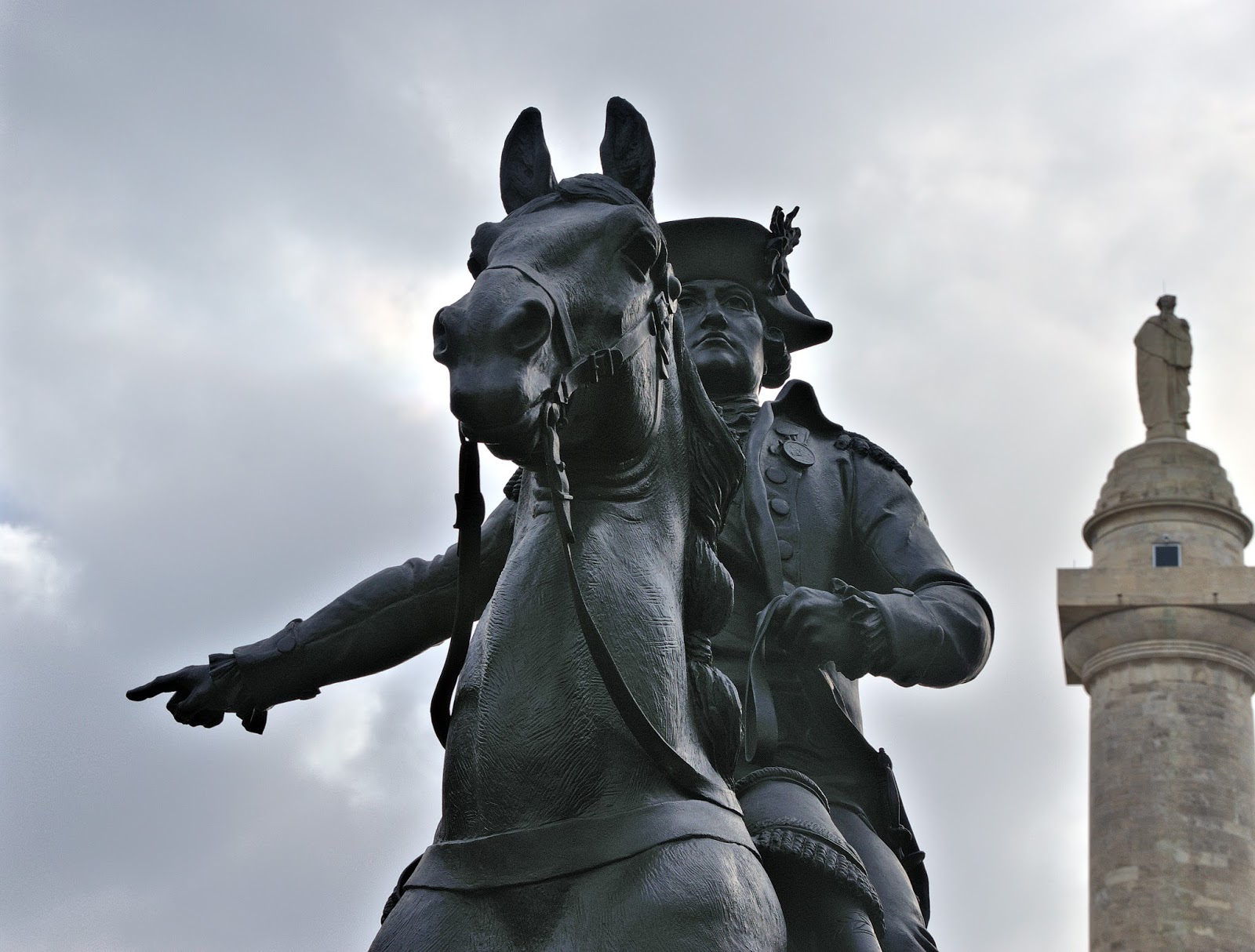
Colonel John Eager Howard

As much as I read and have read about the American Revolution, I am always struck by finding not only reference to, but statuary about, American military leaders below the rank of general in the war that barely penetrate the awareness of the contemporary American and yet were critical to the outcome of that war.  One example is Colonel John Eager Howard, perhaps most well known in Maryland but whose contributions were vastly important to that effort.  His equestrian statue is in the Mount Vernon Place in Baltimore, in the same park as the Washington Monument.


Born in Maryland, he saw action at White Plains as a captain, Germantown as a major, and at Camden, Cowpens, Guilford Court House, Hobkirk's Hill, Ninety Six and Eutaw Springs, holding the rank of Lieutenant Colonel.  He was wounded at Eutaw Springs and unable to fight afterwards; following the war, he served as Maryland's governor from 1788-1791, and in the United States Senate from 1796 through 1803.  His decisive bayonet charge at Cowpens was described by the commanding general, Daniel Morgan in this way: "[Howard's attack] was done with such address that the enemy fled with the utmost precipitation…. We pushed our advantages so effectually, that they never had an opportunity of rallying." As testament to his character and modesty, he not only declined President Washington's offer of Secretary of War, but also a commission as brigadier general in anticipation of war with France in 1798.  He married Peggy Oswald Chew, daughter of the Chief Justice of the Pennsylvania Supreme Court; the Chew house was at the center of the fighting in Germantown.

Resources:

http://www.nps.gov/cowp/learn/historyculture/johneagerhoward.htm

http://bioguide.congress.gov/scripts/biodisplay.pl?index=H000841

http://msa.maryland.gov/megafile/msa/speccol/sc3500/sc3520/000600/000692/html/692bio2.html


Sunday, January 31, 2016

Earthworks

This month is the 240th anniversary of the Battle of Moore's Creek, fought February 27, 1776. British strategy in late 1775 and early 1776 focused on the Southern theater, and representations like those from the bizarre and somewhat delusional Loyalist Governor Josiah Martin fed the British illusion that the populace would rise up and oppose the "rebels." Martin assembled a force of Regulators (a group that during the 1760s had risen up against corrupt local officials, but had deteriorated into a kind of vigilante group), as well as Loyalists and British soldiers.  He sought and obtained permission to place the Scotsman Donald McDonald in charge, with a commission as Brigadier-General.

General James Moore, in command of the 1st North Carolina Regiment,had fought for the Royalist government against the Regulators.  Reinforcements under Colonel Alexander Lillington and others joined him.  Moore's back was to the river, and McDonald saw strategic advantage to attacking him in that position.  Following some maneuvering, by February 26, 1776, the forces found themselves on opposite sides of the Moore's Creek Bridge.  Lillington established earthwork defenses, set up two pieces of artillery and removed a plank from the bridge.  Colonel Richard Caswell reinforced Lillington.

The earthworks formed a semicircle around the bridge on the American side of Moore's Creek and are shown here:


There are various battlefield sites that still have the earthworks preserved. This is remarkable, given the inevitable effect of weather, animals, natural erosion and human traffic in these areas. We are one step removed from those who built these parapets and ditches: their hands on tools, their feet on this ground, their eyes looking over the same defenses we look over. So far in our travels we have not quite encountered this. But as we walk around, and take in the swamp, the woods, the bridge, and as we stand in the same defensive posture as the Americans or come across the bridge as the Loyalists, we can begin to comprehend the courage of those who fought in this war--on both sides.

Tuesday, January 5, 2016

Edgar Allan Poe and the Revolution

On a recent excursion to Baltimore and visit to Edgar Allan Poe's grave at Westminster Hall and Burial Ground, I noticed that his grandfather, David Poe, Sr., was also buried there.  Nearby was the original burial spot of his grandson, Edgar Allan Poe.


The senior Poe was born in 1743 in Londonderry, Northern Ireland.  He served as a major in the Continental Army and was Assistant Deputy-Quartermaster general for Baltimore (though at least one source calls this an honorary position).  Sources also claim he donated $40,000 of his own money to the cause.  Lafayette knew David Poe (they are reported to have fought together) and visited his grave on a visit to Baltimore.  In his early biography of Edgar Allan Poe, James Albert Harrison refers to David Poe as a general (possibly because of the quartermaster role) and "devoted friend of Lafayette).  Edgar Allan Poe also met Lafayette.  As for his own military record, Edgar Allan Poe attended West Point but was court-martialed and was dismissed in 1831.  Still, the connection to Lafayette brings Edgar Allan Poe to within one degree of separation to George Washington.


Tuesday, December 15, 2015

John Paul Jones and Political Correctness

At Annapolis, the corporal remains of John Paul Jones are in a crypt that compares with that of Napoleon in Paris and Ulysses S. Grant in New York:


According to the Naval Academy website, "John Paul Jones has been lauded since 1775 as the Father of the US Navy.  His influence and leadership were foundational in the establishment of our Navy and in many ways the success of our War of Independence." On the other hand, some argue that Commodore John Barry was the real "father" of the American Navy.  (These two schools of thought ignore the role of Benedict Arnold at Valcour Island, and his naval heroics, but that is for another day).  For a discussion of the relative merits of the claim between Barry and Jones, see http://www.usni.org/magazines/navalhistory/2013-07/two-captains-breakfast.

By today's standards, Jones's reputation in retrospect might be subject to question.  He served on two slave ships, for a couple of years, finally leaving it--but he did voluntarily participate as an officer on those ships.  Evan Thomas, in John Paul Jones: Sailor, Hero, Father of the American Navy, wrote that "John Paul sailed the infamous 'middle passage' between Africa and the slave plantations of the Caribbean," worked on slave ships for about three years.  Apart from that, he was charged with murder, but acquitted.  He killed another man while in command of a commercial ship in the West Indies.  His heralded victory while in command of the Bonhomme Richard against the Serapis nonetheless cost half his crew dead or wounded.  A summary of his life is on the website for the John Paul Jones Museum in Scotland, see http://www.jpj.demon.co.uk/.  Among the better biographies is Samuel Eliot Morrison, John Paul Jones: A Sailor's Biography.

Should Jones be de-heroicized? Did he redeem by leaving the trade? Was three years too much to forgive? He made money as a slaver, even if he did purportedly leave the trade due to developing a distaste for it.  There is a memorial to Confederate soldiers in Bolton Hill in Baltimore that has a sign on it asking for comment as to whether it should be taken down.  Is the crypt at Annapolis next?


Thursday, December 10, 2015

Samuel Smith and the Call of Duty

On Federal Hill in Baltimore stands a statue of Samuel Smith.  Smith, who lived into his late eighties, served in both the American Revolution, rising to the rank of Lieutenant Colonel, and then in the War of 1812, leaving the service as a major-general.


Smith was only 24 years old when General George Washington put him in charge of Fort Mifflin on the Philadelphia side of the Delaware River in the fall of 1777.  The bombardment of Fort Mifflin was terrible, among the worst of the war, and ultimately, in November, Smith had to abandon the fort.  He had fought at New York and White Plains, and also Brandywine and Monmouth.  He served in both the Senate and the House of Representatives of the new country, as well as mayor of Baltimore, which he defended against the British during the invasion in the War of 1812.


Sunday, December 6, 2015

Baron Johann de Kalb and Nationality

Baron Johann de Kalb is one of the more intriguing "foreigners" who came to the nascent American nation to join the Patriot (American) forces in the Revolutionary War.  Born in Germany, he was trained by the French and came to America to assess Colonial attitudes towards the British.  Through the intervention of Benjamin Franklin and Lafayette, De Kalb came over with Lafayette in spring 1777 and in September, was appointed a major-general by the Continental Congress.  In command  of the Maryland and Delaware units of the Continental Army, he was mortally wounded at the Battle of Camden in South Carolina on August 16, 1780 and died of his wounds three days later.


He is honored by a statue on the grounds of the Maryland Statehouse in Annapolis, Maryland; the statue was erected in 1866.  Maryland claims his as its own based on his service with the Maryland line in the Revolution.  A plaque at the site claims de Kalb purportedly stated "I die the death I always prayed for: the death of a soldier fighting for the rights of man."

It is worth reflecting on de Kalb and his community of nationalities and loyalties as we ponder current immigration issues.  Here was a German, trained by and in service to the French, and died leading Americans into battle against the British.