Showing posts with label American Revolution. Show all posts

Wednesday, July 27, 2016

Shifting Alliances

The American Civil War is often portrayed as "brother against brother." The West Point class of 1846 yielded classmates Thomas J. "Stonewall" Jackson, Lieutenant General in the Confederate Army, and General George B. McClellan, Commanding General of the Union Army from 1861-62.  Similarly, during the French and Indian War, comrades and arms would face each other as enemies barely twenty years later.


Here is Braddock's Grave on Braddock's Road, not far from Fort Necessity.  British General Edward Braddock was mortally wounded at the Battle of the Monongahela about ten miles east of modern day Pittsburgh, in what is now known as Braddock, Pennsylvania.  The battle occurred on July 9, 1755.  Among the participants and members of Braddock's force were militia Colonel George Washington, Captain Horatio Gates, Lieutenant Colonel Thomas Gage, Captain Charles Lee and Captain William Mercer.  Washington, Gates, Lee and Mercer fought on the American side, and of course Gage on the British, during the Revolution.

As this is written, both Democrats and Republicans continue to engage in their respective civil wars, with former allies bitterly at odds.  It is always intriguing, in a watch the road accident sense, to contemplate betrayals.  People quite literally give their lives to others, and then become discarded when no longer needed or seen as liabilities.  

Thursday, July 7, 2016

The Boot

At Saratoga, at Breymann's Redoubt, Major General Benedict Arnold, holding no orders and otherwise laid aside by the commanding General Horatio Gates, facilitated the assault on this post, with Colonel Daniel Morgan and Major Henry Dearborn attacking head-on.  Arnold is generally credited for the assault on this redoubt (and suffering a shot to the leg) and turning the tide at this second battle at Saratoga, the Battle of Bemis Heights on October 7, 2016.  It was a victory that was obtained in violation of the commanding general's orders.  A plaque at the site consists solely of a boot.


His name is not mentioned on the monument,  National Park Service signage does note the "Arnold Monument." On the back, the soldier who put up the monument, had this inscribed:

 "Erected 1887 By
JOHN WATTS de PEYSTER
Brev: Maj: Gen: S.N.Y.
2nd V. Pres't Saratoga Mon't Ass't'n:
In memory of
the "most brilliant soldier" of the
Continental Army
who was desperately wounded
on this spot the sally port of
BORGOYNES GREAT WESTERN REDOUBT
7th October, 1777
winning for his countrymen
the decisive battle of the
American Revolution
and for himself the rank of

Major General."

As I looked at it, a father was explaining to his daughter what it meant.  She said that Arnold was a traitor.  Her father said that Arnold had done great things for the Revolution, and noted the victory here.  He referred to Arnold as "a maverick" and said sometimes you need that.

I don't defend Arnold's attempted sell-out of West Point or his later treachery and ferocious assaults in aid of the British in the latter part of the war, particularly in his home state of Connecticut, but it was interesting to hear this discussion in such a setting.


Monday, July 4, 2016

The First "Brexit"

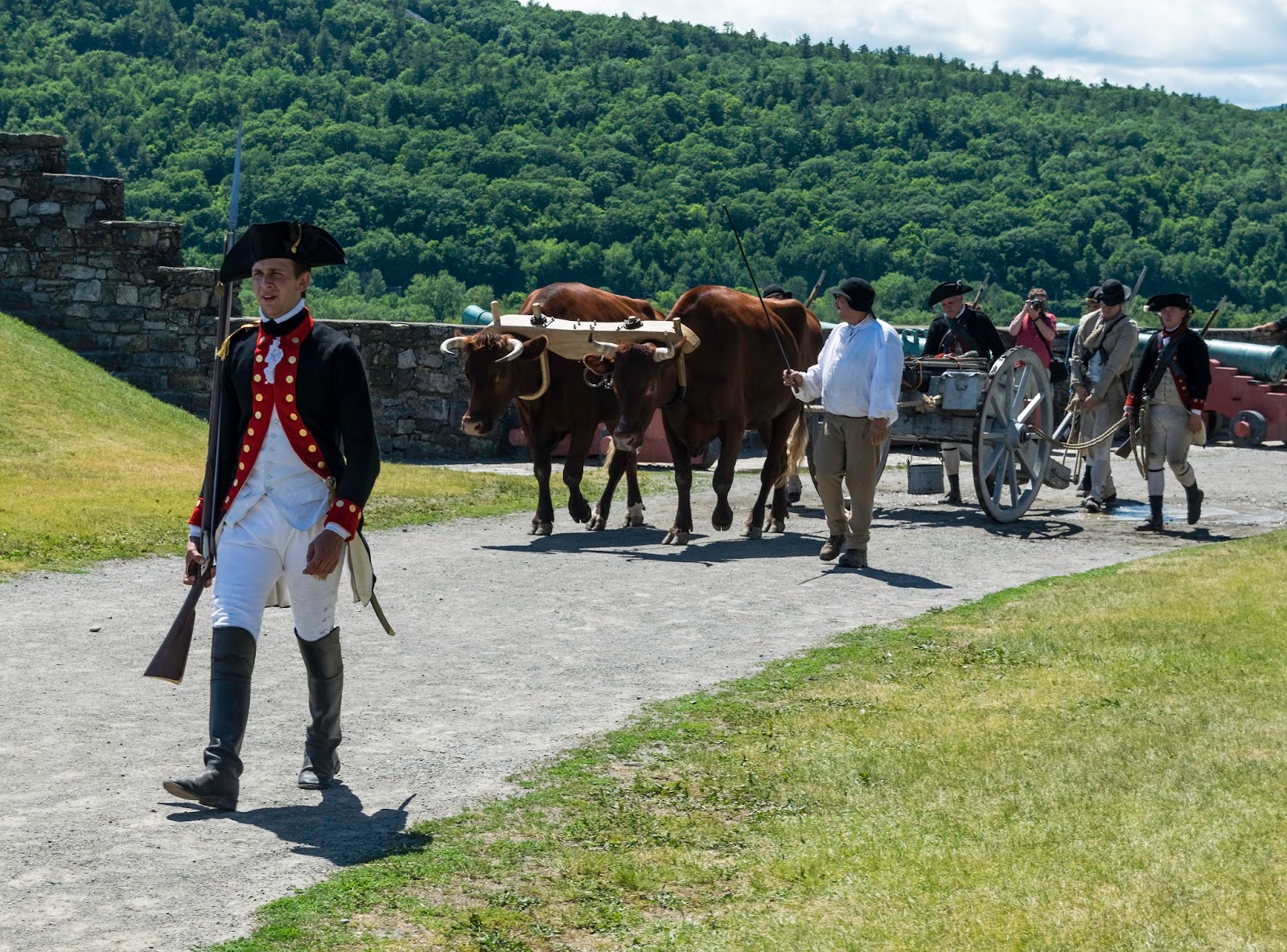
This July 4, 2016 weekend had particular resonance, as it followed by a week or two the monumental vote by the citizens of the United Kingdom to withdraw from the European Union.  I visited both Fort Ticonderoga and Saratoga, two well-preserved and important places for the first Brexit, the withdrawal of the American colonies from the United Kingdom.  Here is a scene from the reenactment activity at Fort Ticonderoga:


I thought of this connection, I must say, before I saw various columnists also drawing the analogy.  The American colonies were not in the same legal posture to the United Kingdom as the United Kingdom was to the EU, but nonetheless, there was a strong economic and sovereignty-related set of arguments.  A better analogy might be if Scotland withdraws from the United Kingdom.  It seems unlikely that the United Kingdom would send an army to retain Scotland, and indeed, the fact that a Scottish exit from the U.K. and return to the E.U. as an independent nation is being discussed as if it is within the realm of possibility.

The Brexit concept is broader and more profound than just this vote.  It is reflective of a different time and mindset in history.  Nations come and go and come again; witness Poland, which literally vanished for a bit as an independent nation. 

Of equal import are the discussions of so-called "Texit," with Texas withdrawing from the United States.  In 1861, an American president sent troops on a four-year campaign to prevent secession.  Would such happen today? Granted, the EU charter provides for such an eventuality within the EU; the American Constitution does not address secession.  However, There is hundred year old Supreme Court authority ruling that a state may not secede from the United States (see Texas v. White, 74 U.S. 700 (1869)).

The King and Parliament no doubt thought the law precluded American independence.  The Declaration of Independence was at odds with that and, if read literally and in its essence, would also be at odds with those who find permanence to political boundaries drawn long ago.

Sunday, January 31, 2016

Earthworks

This month is the 240th anniversary of the Battle of Moore's Creek, fought February 27, 1776. British strategy in late 1775 and early 1776 focused on the Southern theater, and representations like those from the bizarre and somewhat delusional Loyalist Governor Josiah Martin fed the British illusion that the populace would rise up and oppose the "rebels." Martin assembled a force of Regulators (a group that during the 1760s had risen up against corrupt local officials, but had deteriorated into a kind of vigilante group), as well as Loyalists and British soldiers.  He sought and obtained permission to place the Scotsman Donald McDonald in charge, with a commission as Brigadier-General.

General James Moore, in command of the 1st North Carolina Regiment,had fought for the Royalist government against the Regulators.  Reinforcements under Colonel Alexander Lillington and others joined him.  Moore's back was to the river, and McDonald saw strategic advantage to attacking him in that position.  Following some maneuvering, by February 26, 1776, the forces found themselves on opposite sides of the Moore's Creek Bridge.  Lillington established earthwork defenses, set up two pieces of artillery and removed a plank from the bridge.  Colonel Richard Caswell reinforced Lillington.

The earthworks formed a semicircle around the bridge on the American side of Moore's Creek and are shown here:


There are various battlefield sites that still have the earthworks preserved. This is remarkable, given the inevitable effect of weather, animals, natural erosion and human traffic in these areas. We are one step removed from those who built these parapets and ditches: their hands on tools, their feet on this ground, their eyes looking over the same defenses we look over. So far in our travels we have not quite encountered this. But as we walk around, and take in the swamp, the woods, the bridge, and as we stand in the same defensive posture as the Americans or come across the bridge as the Loyalists, we can begin to comprehend the courage of those who fought in this war--on both sides.

Tuesday, January 5, 2016

Edgar Allan Poe and the Revolution

On a recent excursion to Baltimore and visit to Edgar Allan Poe's grave at Westminster Hall and Burial Ground, I noticed that his grandfather, David Poe, Sr., was also buried there.  Nearby was the original burial spot of his grandson, Edgar Allan Poe.


The senior Poe was born in 1743 in Londonderry, Northern Ireland.  He served as a major in the Continental Army and was Assistant Deputy-Quartermaster general for Baltimore (though at least one source calls this an honorary position).  Sources also claim he donated $40,000 of his own money to the cause.  Lafayette knew David Poe (they are reported to have fought together) and visited his grave on a visit to Baltimore.  In his early biography of Edgar Allan Poe, James Albert Harrison refers to David Poe as a general (possibly because of the quartermaster role) and "devoted friend of Lafayette).  Edgar Allan Poe also met Lafayette.  As for his own military record, Edgar Allan Poe attended West Point but was court-martialed and was dismissed in 1831.  Still, the connection to Lafayette brings Edgar Allan Poe to within one degree of separation to George Washington.


Tuesday, December 15, 2015

John Paul Jones and Political Correctness

At Annapolis, the corporal remains of John Paul Jones are in a crypt that compares with that of Napoleon in Paris and Ulysses S. Grant in New York:


According to the Naval Academy website, "John Paul Jones has been lauded since 1775 as the Father of the US Navy.  His influence and leadership were foundational in the establishment of our Navy and in many ways the success of our War of Independence." On the other hand, some argue that Commodore John Barry was the real "father" of the American Navy.  (These two schools of thought ignore the role of Benedict Arnold at Valcour Island, and his naval heroics, but that is for another day).  For a discussion of the relative merits of the claim between Barry and Jones, see http://www.usni.org/magazines/navalhistory/2013-07/two-captains-breakfast.

By today's standards, Jones's reputation in retrospect might be subject to question.  He served on two slave ships, for a couple of years, finally leaving it--but he did voluntarily participate as an officer on those ships.  Evan Thomas, in John Paul Jones: Sailor, Hero, Father of the American Navy, wrote that "John Paul sailed the infamous 'middle passage' between Africa and the slave plantations of the Caribbean," worked on slave ships for about three years.  Apart from that, he was charged with murder, but acquitted.  He killed another man while in command of a commercial ship in the West Indies.  His heralded victory while in command of the Bonhomme Richard against the Serapis nonetheless cost half his crew dead or wounded.  A summary of his life is on the website for the John Paul Jones Museum in Scotland, see http://www.jpj.demon.co.uk/.  Among the better biographies is Samuel Eliot Morrison, John Paul Jones: A Sailor's Biography.

Should Jones be de-heroicized? Did he redeem by leaving the trade? Was three years too much to forgive? He made money as a slaver, even if he did purportedly leave the trade due to developing a distaste for it.  There is a memorial to Confederate soldiers in Bolton Hill in Baltimore that has a sign on it asking for comment as to whether it should be taken down.  Is the crypt at Annapolis next?


Tuesday, October 27, 2015

The American Occupation of Montreal

American General Richard Montgomery took Montreal on November 13, 1775.  One of the remaining landmarks of that time is Chateau Ramezay, finished in 1705, shown here:


The American forces used the Chateau as their headquarters in 1775.  The taking of Montreal was prelude to the assault on Quebec City. Two months earlier, on September 25, 1775, at the Battle of Longue-Pointe, Ethan Allen failed in his attempt to take the city.

It was all for naught.  Montgomery met up with Benedict Arnold outside Quebec City; Montgomery was killed in the assault and Arnold seriously wounded.  Although capturing Canada remained in the mind of Washington and others, it was an ill-assumed premise that proved costly and, if anything, further united the Canadians against the Americans.

Wednesday, March 18, 2015

The War in the Caribbean

I have commented previously on the Battle of Nassau in the Bahamas as part of the war in the Caribbean.  It must be remembered that the Revolutionary War involved more than the British, French and Americans; Spain was also an ally of the Americans and opposed to the British.  The  Castillo De Los Tres Reyes Del Morro (Morro Castle), was designed and built in the 16th century, and saw action during the French and Indian War.  On August 13, 1762, following a 42 day seige, 14,000 British soldiers successfully attacked the fort and Havana.  It was returned to the Spanish after the war.


The American ship, Alliance, commanded by John Barry, sailed past Morro Castle in January 1783.  His orders were to pick up gold and transport it to Philadelphia.  He made Havana on January 31, 1783, finding another American ship, Duc de Lauzun, in Havana harbor with the same orders, and already in possession of the gold.  They left the port--sailing these waters in the image--and ended up in battle with the British off what is now Cape Canaveral, Florida.

Sunday, December 7, 2014

The Haunted Revolution

Perth Amboy, New Jersey, is an underappreciated place.  It has the Proprietary House, reportedly the only colonial governor's mansion still "intact." William Franklin, the illegitimate son of Ben Franklin, was the last British colonial governor for New Jersey, and lived here.  Its city hall is also reported to be the oldest in continuous use in the United States, its current version dating to 1767 in essential form.  There are those who contend that Franklin continues to "live" there. 


Nearby is St. Peter's Church, which graveyard was damaged in June 1776 by British cannon fire from its ships in Raritan Bay.

A municipal worker, helping ready the city hall for the holiday season, told me this is where the nation was born.  The city was the capital of the province of East Jersey, and in the city hall, New Jersey became the first state to ratify the Bill of Rights.  Across from the city hall is Market Square, a park that features an arch in honor of the Bill of Rights.  It was refreshing to find a spontaneous expression of pride from a local, and an appreciation of the this place's significance in the national story.  In a way, the ghosts of the past continue to live in such concourse.

Friday, November 28, 2014

Lafayette Sculpted

In the park behind the Philadelphia Art Museum are statues of various Revolutionary War officers: Baron von Steuben, Nathanael Greene, John Paul Jones, Peter Muhlenberg and Richard Montgomery.  Also present is Lafayette who, like some rock stars today, is generally known by his one name.


When viewed against the setting sun, he appears to be winged, giving fancy to the image of an angel.  There is no discounting his personal courage or conviction, but as to military prowess, his record on the battlefield cannot be said to have been dispositive.  To the contrary, he was almost destroyed at Barren Hill.  Nonetheless, there was (and remains) great affection for him; certainly Washington treated him as a favored son.  His "value" may also have been in the political connections with France that proved useful in cementing French support for the cause.  

It was a cold November evening when I wandered among the statues of these men.  Most jogged past without a glance, but one other person was captivated by the statue, and stood on a bench to take his picture of Lafayette. 

We read and hear constantly about contemporary politicians doing this or that for their "legacy." True character comes from within, and those who are great do what they do regardless of whether others note it at the time or not.  Legacies are commanded, not demanded.  Perhaps that is why Lafayette's reputation and appeal persist today in the lay imagination: he did what he did from belief and conviction, not based on polls and narcissism.  

Monday, September 1, 2014

The Revolution and Canada II

Notwithstanding the failure to capture Quebec in 1775 and early 1776, the Second Continental Congress authorized further attacks into Canada.  In 1777, it directed a Canadian turncoat, John Allan, to lead a Massachusetts militia unit in an attack on Saint John (now New Brunswick; then part of Nova Scotia).  The goal was an American presence in the western part of Nova Scotia in an effort to ally that province with the American cause.  American privateering activity had already taken its toll in the area.  On June 2, 1777 Allan and about 43 soldiers, including Indians, captured two of the town's leaders and gained a foothold, to be driven out by the end of June.  Nonetheless, Allan succeeded in turning the Maliseet Indians into allies.

The British built Fort Howe by the end of 1777 to protect the area from further incursion.  Below is a picture of the recreated blockhouse that stood nearby.


Sunday, August 31, 2014

Valcour Island and the Lessons of History

It is easy to see Valcour Island from the boat launch at Peru, New York, and from the campus of Clinton County Community College at Bluff's Point, but not from the vicinity of the New York State Marker along Route 9 that purports to identify the area of the action.  There is a conference center there (private property).  One wold think that such an important battle would not only not be so generally ignored in discussions of the war for the lay person, but would also have a small dedicated parking and viewing area by the roadside.

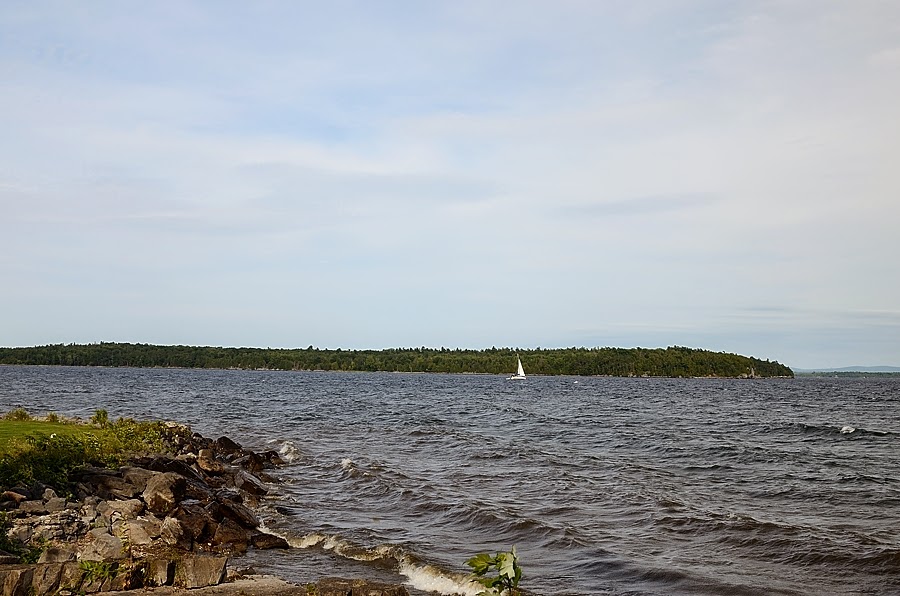
Anyway, here's a view of the strait near the sign that shows the vicinity of the battle.


There are those who credit Benedict Arnold with creating and commanding America's first navy.  It was here, in the straight between the New York mainland (shown in foreground) and Valcour Island (showing the island to its southern tip) that, on October 11, 1776, Arnold stopped the pursuit of Guy Carleton, commander-in-chief of the British forces in Canada, following Arnold's withdrawal from the siege of Quebec in spring 1776.

The only other plaque I found apart from the one by Route 9 was at Bluff's Point.  We should always recall the words of George Santayana that "Those who cannot remember the past are condemned to repeat it," although Edmund Burke far more contemporaneous to the Revolution, also reportedly said, “Those who don't know history are doomed to repeat it.” The war might well have been crushed before it began but for Arnold's determined and heroic stand in these waters, yet you could not tell it from the minimal coverage here. 

Sunday, August 17, 2014

The Revolution and Canada I

Among the histories of the Revolutionary War I have read, discussion of Canada is limited generally to the attacks on Montreal and Quebec, and the subsequent battles during the withdrawal of the Americans.  What may not be readily understood is the more global impact of the war on other regions in Canada--such as distant Newfoundland.

Here is the site of Fort Townshend in St. John's.


We can see in the middle distance the Southern Hills that forms part of the Narrows leading into the harbor.  Fort Townshend was built between 1773 and 1779 and headquartered the British garrison in Newfoundland during the Revolution.  

The Heritage Website of Newfoundland and Labrador notes the deleterious effect on the Newfoundland economy as trade was disrupted through political acts and the sea routes subjected to the effect of the war, privateers and naval action.  When Spain joined the American-French side, Newfoundland lost another market.  Nonetheless, Newfoundlanders did not sympathize with or join the American cause.  

IN 1778 the Newfoundland Volunteers was organized and constructed Fort Townshend; two years later, the Newfoundland Regiment was formed with 300 men to defend Newfoundland, under command of Captain Robert Pringle.

Today, Newfoundland is a 2 1/3 hour flight from Newark, New Jersey.  Despite that remoteness from the epicenter of the American Revolution, the economic and political effects of the war reverberated to the furthest reaches of colonized North America.


Saturday, June 28, 2014

Battle of Monmouth Anniversary

Today, June 28, 2014, marks the 236th anniversary of the Battle of Monmouth, in New Jersey.  I have noted Monmouth in a couple of prior posts.  Today we look at the spot, marked by this sign, on Perrine Hill where General George Washington rallied and reformed Continental forces in view of General Charles Lee's retreat.


General Henry Clinton was moving the British forces from Philadelphia to Sandy Point to depart for New York.  Washington paralleled his movements to the north across New Jersey, and sought what he hoped would be a dispositive encounter with Clinton.  They came together at Monmouth.  A long battle, it resulted in the Americans retaining the field and Clinton continuing his withdrawal--in short, a draw, though often hailed as an American victory.

Putting all that aside, this is my favorite spot on the battlefield, because we are standing in the place where Washington took charge and regained control of the troop.  We can see him on his horse moving back and forth here, and we can see what he saw as he looked out over the battlefield.  It is one of those places that remains close to how it was then, and transports us across time to see and feel (and, on a hot day like today, especially) gain a sense of place.

Sunday, April 6, 2014

The Revolution and Contemporary Secession

I've talked in other posts about the Patriot invasion of Canada during the Revolution, and the taking of Montreal and the assault on Quebec.  Here is a view of the St. Louis Gate that saw some action during the Battle of Quebec on December 31, 1775.


General George Washington, placed in overall command of the American forces after Lexington and Concord, attempted a direct outreach to the Canadian citizenry.  By letter dated September 6, 1775, he attempted to vilify the British and justify American action.  He minced no words, and indulged in his own inflamed rhetoric.  He told them that "the Great American Congress have sent an Army into your Province . . . not to plunder but to protect you." Ironically, the Southern slaveowner wrote to the Canadians that "[t]he cause of America and of liberty is the cause of every virtuous American Citizen Whatever may be his Religion or his descent, the United Colonies know no distinction, but such as Slavery, Corruption and Arbitrary Domination may create."

We of course then invaded Canada in an attempt to seize Canadian territory and make it part of America, as the fourteenth colony.

There is a pending election in Quebec that will determine if a referendum on Quebec separation will be held, as well as in the United Kingdom, a pending referendum in Scotland on secession.   One wonders if the Patriots under Benedict Arnold and Richard Montgomery had succeeded in capturing and holding Quebec if "Canada" would have remained as part of colonies that signed the Articles of Confederation and then the Constitution, and if so, how the United States would react to such referendums.  We of course fought a civil war to preserve the union.  We now also have had some states that were independent nations, however briefly.  And there are certain counties in certain places that are seeking to establish themselves as separate states within the U.S.  Not necessarily new or unique thoughts to think about, but made topical as we watch Scotland and Quebec.

Saturday, March 1, 2014

Alamance Revisited

I previously blogged about Alamance, that some have labeled the "first" battle of the American Revolution.  Regardless of that "debate," Alamance, North Carolina was the scene of its own real skirmish during the Revolution, which anniversary comes up on March 5.  Here is a view of the battlefield today.


A plaque on the site notes an encounter on March 5, 1781 between members of the Delaware Light Infantry under Captain Robert Kirkwood and some British units.  In the Journal and Order Book of Capt. Robert Kirkwood, the entry for March 5,1781 states: "Marched this Night to the old Regulation ground and attack'd the advanc'd picquet.  Brought off one of their Centinells & returned to Camp by morning." 

Saturday, January 18, 2014

Why We Honor Lafayette

The man who designed the Statue of Liberty, Frédéric-Auguste Bartholdi, is responsible for the bronze statue of Marquis de Lafayette in Union Square in New York.


This statue was cast in 1873 and dedicated in 1876, according to the NYC Parks webpage on it.  A gift from the French government, by way of gratitude for aid given by New York City to the French during the Franco-Prussian War.  When the American forces arrived in Paris during the First World War, Lieutenant Colonel Charles Stanton (not General John Pershing) uttered the words "Lafayette, we are here" before the French general's grave.  There are Fayette Counties around the country named for him.

While his courage under fire was demonstrated, his lack of real military experience almost led to disaster at Barren Hill.  Nonetheless, a favorite of George Washington, he also gave significant diplomatic service in maintaining French-American relations.  Still, the fascination and respect afforded Lafayette, like that to Pulaski, Kosciusko, von Steuben and other foreign figures that were generals and officers in the American Revolution, seems to attest to the universality of the philosophical underpinnings of the Revolution.  It also speaks to another time in which people literally put their money where their mouth was, and even more literally, their lives.  These were not the "hit and run" commentators of today's digital world, striking through 140 character comments in the ether.  

We wander our cities and see these statues as part of the landscape, but it is good to remember who these people were and why they continue to be in our consciousness today.

Sunday, October 27, 2013

White Plains Anniversary

October 28 marks the anniversary of the Battle of White Plains in 1776; I posted on this battle last year around this time.  At that time I posted a picture of Chatterton Hill and focused on the Hessians.  Here is a picture of a different part of the battlefield, the eastern limit of the Patriot defenses, marked by a cannon.


On Merritt Hill itself, Colonel William Malcolm and the American 2nd New York County Battalion held position.  Before the war, Malcolm was a Scottish businessman who came to New York in 1763.  There are a few signs around Merritt Hill indicating its part of the battle of White Plains, but most evocative to me was this cannon set on a rock towards the bottom of the hill.  This plaque indicates it marks "the eastern limit of the Patriot defenses . . . The high ground to the south of this spot was occupied by the New York Regiment of Colonel William Malcolm. The hill to the north was occupied by the regiments under Major General William Heath.  On October 28, and again on November 1, attempted enemy attacks upon these positions were turned back." 


Monday, October 21, 2013

Lord Nelson and the Revolution

     Admiral Horatio Nelson, honored in Trafalgar Square, is perhaps most famous for his victory in that eponymous battle during the Napoleonic Wars.


     Lord Nelson also saw action during the American Revolution, serving on board the HMS Lowestoffe and then the Little Lucy in the Caribbean.  Serving with Jamaica's commander in chief, Sir Parker Peter aboard the HMS Bristol after the French entered the war, he was given command of his own ship, the HMS Badger, and continued his activity in seeking to capture prizes.  Later he served on other ships and was involved in the British defense of the Caribbean and activity in Central America, an aspect of the Revolution that does not get much attention.  To that extent, Nelson is emblematic of the broader world war of which the American battle of independence was one part.

Sunday, September 8, 2013

Savannah and the Multicultural American Revolution

The siege of Savannah lasted from September 16 to October 18, 1779, and essentially ended on October 9 when a joint French-American assault on a fortified British position ended in disaster, claiming among others, the Polish general Casimir Pulaski.  The French forces included some 500 Haitian volunteers from Saint-Domingue.  A monument in Savannah memorializes this contribution.


Though still under French authority at this time, the Les Chasseurs Volontaires de Saint Domingue were free men who fought on the American side.  It provides a contrast to the ambivalence, if not original hostility, of Washington to allowing slaves or freed slaves to fight in the Continental Army.l