Showing posts with label Revolutionary War. Show all posts

Wednesday, July 27, 2016

Shifting Alliances

The American Civil War is often portrayed as "brother against brother." The West Point class of 1846 yielded classmates Thomas J. "Stonewall" Jackson, Lieutenant General in the Confederate Army, and General George B. McClellan, Commanding General of the Union Army from 1861-62.  Similarly, during the French and Indian War, comrades and arms would face each other as enemies barely twenty years later.


Here is Braddock's Grave on Braddock's Road, not far from Fort Necessity.  British General Edward Braddock was mortally wounded at the Battle of the Monongahela about ten miles east of modern day Pittsburgh, in what is now known as Braddock, Pennsylvania.  The battle occurred on July 9, 1755.  Among the participants and members of Braddock's force were militia Colonel George Washington, Captain Horatio Gates, Lieutenant Colonel Thomas Gage, Captain Charles Lee and Captain William Mercer.  Washington, Gates, Lee and Mercer fought on the American side, and of course Gage on the British, during the Revolution.

As this is written, both Democrats and Republicans continue to engage in their respective civil wars, with former allies bitterly at odds.  It is always intriguing, in a watch the road accident sense, to contemplate betrayals.  People quite literally give their lives to others, and then become discarded when no longer needed or seen as liabilities.  

Sunday, July 24, 2016

Where It All Began

The American historian Francis Parkman wrote in 1897 of Jumonville that, "[j]udge it as we may, this obscure skirmish began the war that set the world on fire." The incident led to the French and Indian war in North America, and the Seven Years War as it was known in Europe, which in turn set the stage for the Revolutionary War as much as World War in set the stage for World War II.  Here is the scene:


George Washington had been sent to the region by Virginia's Royal Governor, Robert Dinwiddie, to advise French military personnel to leave.  After an initial such overture failed, Washington, now a Lieutenant Colonel in the militia, returned and allied with Indian chiefs Tanacharison and Monacatootha, and about 10 warriors.  Washington was accompanied by Captain Adam Sephen; between them, they had about 40 British soldiers.  They surprised Ensign Joseph Coulon de Villiers de Jumonville and his 31 soldiers camping here after prior negotiations failed.  The French were slaughtered, and Tanacharison bashed in the wounded Jumonville's skull.  The event set in motion the ensuing French and Indian War.

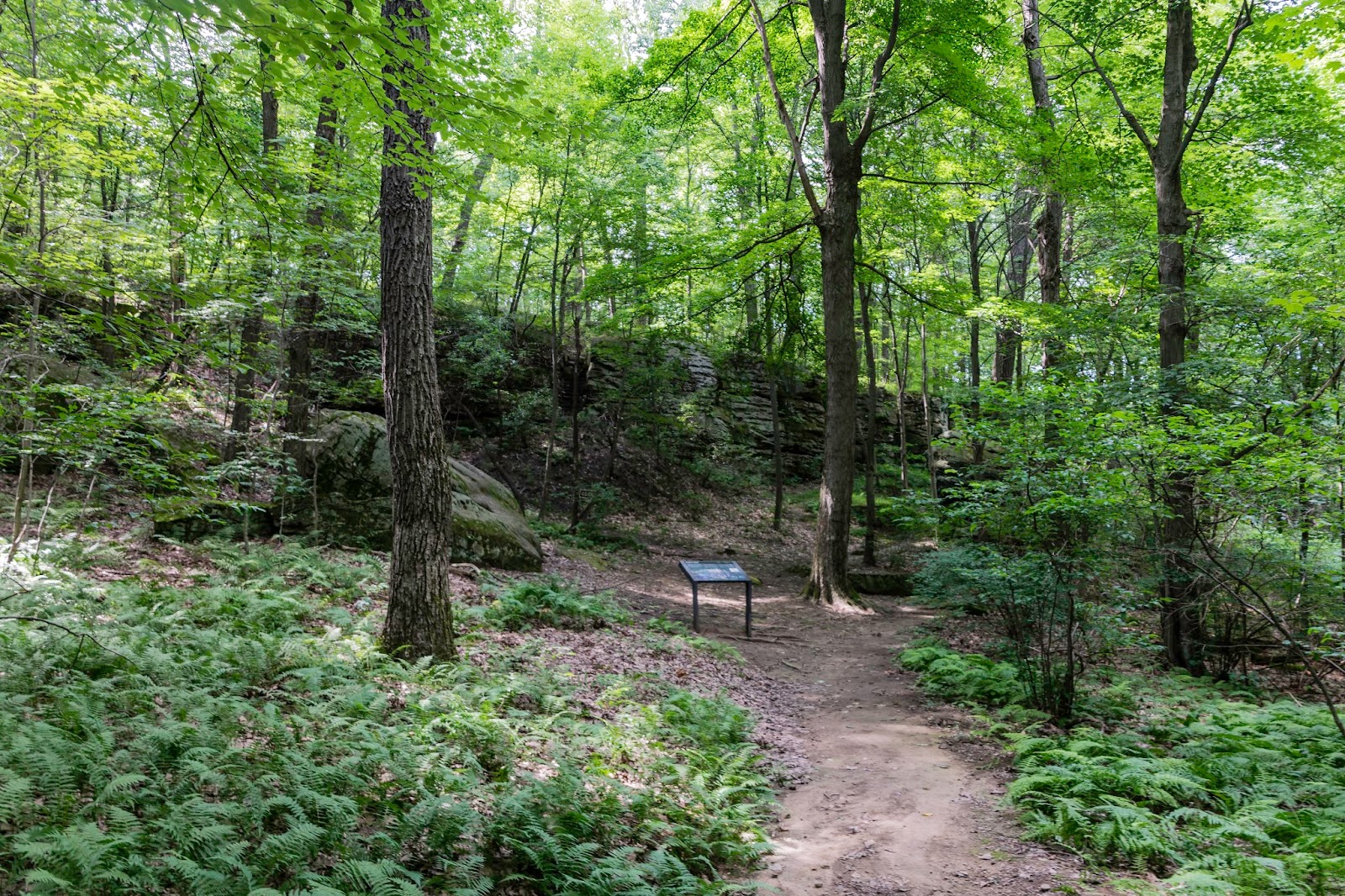
It is a remarkable place to stand and absorb what happened here, in this still preserved wildnerness niche.  Stephen and his men came over the ledge of rock, while Washington came from the left, and the Native Americans from the right, cutting off the French attempt at escape.


Thursday, July 7, 2016

The Boot

At Saratoga, at Breymann's Redoubt, Major General Benedict Arnold, holding no orders and otherwise laid aside by the commanding General Horatio Gates, facilitated the assault on this post, with Colonel Daniel Morgan and Major Henry Dearborn attacking head-on.  Arnold is generally credited for the assault on this redoubt (and suffering a shot to the leg) and turning the tide at this second battle at Saratoga, the Battle of Bemis Heights on October 7, 2016.  It was a victory that was obtained in violation of the commanding general's orders.  A plaque at the site consists solely of a boot.


His name is not mentioned on the monument,  National Park Service signage does note the "Arnold Monument." On the back, the soldier who put up the monument, had this inscribed:

 "Erected 1887 By
JOHN WATTS de PEYSTER
Brev: Maj: Gen: S.N.Y.
2nd V. Pres't Saratoga Mon't Ass't'n:
In memory of
the "most brilliant soldier" of the
Continental Army
who was desperately wounded
on this spot the sally port of
BORGOYNES GREAT WESTERN REDOUBT
7th October, 1777
winning for his countrymen
the decisive battle of the
American Revolution
and for himself the rank of

Major General."

As I looked at it, a father was explaining to his daughter what it meant.  She said that Arnold was a traitor.  Her father said that Arnold had done great things for the Revolution, and noted the victory here.  He referred to Arnold as "a maverick" and said sometimes you need that.

I don't defend Arnold's attempted sell-out of West Point or his later treachery and ferocious assaults in aid of the British in the latter part of the war, particularly in his home state of Connecticut, but it was interesting to hear this discussion in such a setting.


Saturday, June 25, 2016

The Minuteman, Elizabeth and the Battle of Springfield

Apologies for the delay between posts.  This one notes the Minuteman monument in Elizabeth, New Jersey, shown below:


The Battle of Springfield, whose anniversary is this month, took place on June 23, 1780.  A British and Hessian force of some 6,000 under  Lieutenant General Wilhelm, Baron von Knyphausen landed at Elizabethport, seeking to attack Washington's army in northern New Jersey.  This area of Elizabeth, on Elizabeth Avenue at what is now Union Square, was the opening salvo.  A small contingent of minuteman were involved, and the British and Hessians moved in two columns through Connecticut Farms (now Union Township) where the British and Hessians were delayed, but victorious on June 7. They continued on towards Springfield, where they were forced to retreat.

Although the prime effort of the British was in the Carolinas at this point, had this attack succeeded for the British, it could have had a far more significant impact on war.  It failed, and has been relegated to not much more than a footnote in histories of the war, but the argument may be made that its importance has been understated.

In the context of today's Elizabeth, this seemingly incongruous monument is a vivid reminder of the importance of this battle and the close calls that often marked the activity in the Revolution.

Saturday, March 26, 2016

Spain and the American Revolution

Most people think only of France when they think of American allies during the Revolutionary War.  Some may recall the contributions of individual military officers, such as Von Steuben or Pulaski, and think of other countries.  Often overlooked, though, was the contribution of Spain to the American cause.

In a small park in the middle of downtown Philadelphia stands a statue of Don Diego de Gardoqui, who became Spain's first ambassador to the United States.


Born in 1735, he was a Spanish businessman in a successful family business.  He served as a financial intermediary for Spain with the Americans, interacting with John Jay.  Through him, Spain supplied significant arms and munitions.  He died in 1798.

In a letter to Gardoqui after the war, dated January 20, 1786 from Mount Vernon, George Washington noted Gardoqui as one "whose good wishes were early engaged in the American cause, and who has attended to its progress thro' the various stages of the revolution."

Sunday, February 14, 2016

Colonel John Eager Howard

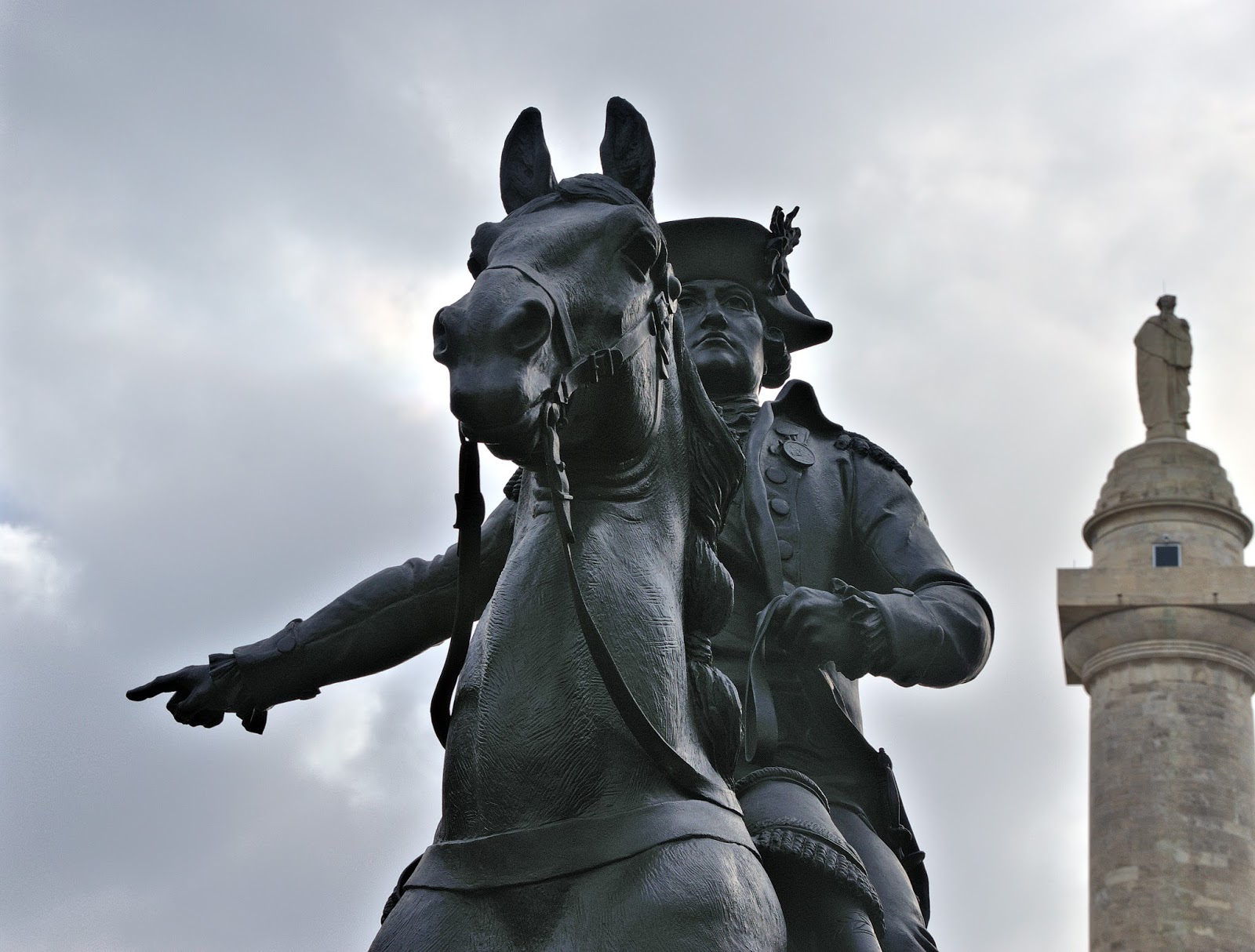
As much as I read and have read about the American Revolution, I am always struck by finding not only reference to, but statuary about, American military leaders below the rank of general in the war that barely penetrate the awareness of the contemporary American and yet were critical to the outcome of that war.  One example is Colonel John Eager Howard, perhaps most well known in Maryland but whose contributions were vastly important to that effort.  His equestrian statue is in the Mount Vernon Place in Baltimore, in the same park as the Washington Monument.


Born in Maryland, he saw action at White Plains as a captain, Germantown as a major, and at Camden, Cowpens, Guilford Court House, Hobkirk's Hill, Ninety Six and Eutaw Springs, holding the rank of Lieutenant Colonel.  He was wounded at Eutaw Springs and unable to fight afterwards; following the war, he served as Maryland's governor from 1788-1791, and in the United States Senate from 1796 through 1803.  His decisive bayonet charge at Cowpens was described by the commanding general, Daniel Morgan in this way: "[Howard's attack] was done with such address that the enemy fled with the utmost precipitation…. We pushed our advantages so effectually, that they never had an opportunity of rallying." As testament to his character and modesty, he not only declined President Washington's offer of Secretary of War, but also a commission as brigadier general in anticipation of war with France in 1798.  He married Peggy Oswald Chew, daughter of the Chief Justice of the Pennsylvania Supreme Court; the Chew house was at the center of the fighting in Germantown.

Resources:

http://www.nps.gov/cowp/learn/historyculture/johneagerhoward.htm

http://bioguide.congress.gov/scripts/biodisplay.pl?index=H000841

http://msa.maryland.gov/megafile/msa/speccol/sc3500/sc3520/000600/000692/html/692bio2.html


Sunday, January 31, 2016

Earthworks

This month is the 240th anniversary of the Battle of Moore's Creek, fought February 27, 1776. British strategy in late 1775 and early 1776 focused on the Southern theater, and representations like those from the bizarre and somewhat delusional Loyalist Governor Josiah Martin fed the British illusion that the populace would rise up and oppose the "rebels." Martin assembled a force of Regulators (a group that during the 1760s had risen up against corrupt local officials, but had deteriorated into a kind of vigilante group), as well as Loyalists and British soldiers.  He sought and obtained permission to place the Scotsman Donald McDonald in charge, with a commission as Brigadier-General.

General James Moore, in command of the 1st North Carolina Regiment,had fought for the Royalist government against the Regulators.  Reinforcements under Colonel Alexander Lillington and others joined him.  Moore's back was to the river, and McDonald saw strategic advantage to attacking him in that position.  Following some maneuvering, by February 26, 1776, the forces found themselves on opposite sides of the Moore's Creek Bridge.  Lillington established earthwork defenses, set up two pieces of artillery and removed a plank from the bridge.  Colonel Richard Caswell reinforced Lillington.

The earthworks formed a semicircle around the bridge on the American side of Moore's Creek and are shown here:


There are various battlefield sites that still have the earthworks preserved. This is remarkable, given the inevitable effect of weather, animals, natural erosion and human traffic in these areas. We are one step removed from those who built these parapets and ditches: their hands on tools, their feet on this ground, their eyes looking over the same defenses we look over. So far in our travels we have not quite encountered this. But as we walk around, and take in the swamp, the woods, the bridge, and as we stand in the same defensive posture as the Americans or come across the bridge as the Loyalists, we can begin to comprehend the courage of those who fought in this war--on both sides.

Tuesday, January 5, 2016

Edgar Allan Poe and the Revolution

On a recent excursion to Baltimore and visit to Edgar Allan Poe's grave at Westminster Hall and Burial Ground, I noticed that his grandfather, David Poe, Sr., was also buried there.  Nearby was the original burial spot of his grandson, Edgar Allan Poe.


The senior Poe was born in 1743 in Londonderry, Northern Ireland.  He served as a major in the Continental Army and was Assistant Deputy-Quartermaster general for Baltimore (though at least one source calls this an honorary position).  Sources also claim he donated $40,000 of his own money to the cause.  Lafayette knew David Poe (they are reported to have fought together) and visited his grave on a visit to Baltimore.  In his early biography of Edgar Allan Poe, James Albert Harrison refers to David Poe as a general (possibly because of the quartermaster role) and "devoted friend of Lafayette).  Edgar Allan Poe also met Lafayette.  As for his own military record, Edgar Allan Poe attended West Point but was court-martialed and was dismissed in 1831.  Still, the connection to Lafayette brings Edgar Allan Poe to within one degree of separation to George Washington.


Tuesday, December 15, 2015

John Paul Jones and Political Correctness

At Annapolis, the corporal remains of John Paul Jones are in a crypt that compares with that of Napoleon in Paris and Ulysses S. Grant in New York:


According to the Naval Academy website, "John Paul Jones has been lauded since 1775 as the Father of the US Navy.  His influence and leadership were foundational in the establishment of our Navy and in many ways the success of our War of Independence." On the other hand, some argue that Commodore John Barry was the real "father" of the American Navy.  (These two schools of thought ignore the role of Benedict Arnold at Valcour Island, and his naval heroics, but that is for another day).  For a discussion of the relative merits of the claim between Barry and Jones, see http://www.usni.org/magazines/navalhistory/2013-07/two-captains-breakfast.

By today's standards, Jones's reputation in retrospect might be subject to question.  He served on two slave ships, for a couple of years, finally leaving it--but he did voluntarily participate as an officer on those ships.  Evan Thomas, in John Paul Jones: Sailor, Hero, Father of the American Navy, wrote that "John Paul sailed the infamous 'middle passage' between Africa and the slave plantations of the Caribbean," worked on slave ships for about three years.  Apart from that, he was charged with murder, but acquitted.  He killed another man while in command of a commercial ship in the West Indies.  His heralded victory while in command of the Bonhomme Richard against the Serapis nonetheless cost half his crew dead or wounded.  A summary of his life is on the website for the John Paul Jones Museum in Scotland, see http://www.jpj.demon.co.uk/.  Among the better biographies is Samuel Eliot Morrison, John Paul Jones: A Sailor's Biography.

Should Jones be de-heroicized? Did he redeem by leaving the trade? Was three years too much to forgive? He made money as a slaver, even if he did purportedly leave the trade due to developing a distaste for it.  There is a memorial to Confederate soldiers in Bolton Hill in Baltimore that has a sign on it asking for comment as to whether it should be taken down.  Is the crypt at Annapolis next?


Thursday, December 10, 2015

Samuel Smith and the Call of Duty

On Federal Hill in Baltimore stands a statue of Samuel Smith.  Smith, who lived into his late eighties, served in both the American Revolution, rising to the rank of Lieutenant Colonel, and then in the War of 1812, leaving the service as a major-general.


Smith was only 24 years old when General George Washington put him in charge of Fort Mifflin on the Philadelphia side of the Delaware River in the fall of 1777.  The bombardment of Fort Mifflin was terrible, among the worst of the war, and ultimately, in November, Smith had to abandon the fort.  He had fought at New York and White Plains, and also Brandywine and Monmouth.  He served in both the Senate and the House of Representatives of the new country, as well as mayor of Baltimore, which he defended against the British during the invasion in the War of 1812.


Sunday, December 6, 2015

Baron Johann de Kalb and Nationality

Baron Johann de Kalb is one of the more intriguing "foreigners" who came to the nascent American nation to join the Patriot (American) forces in the Revolutionary War.  Born in Germany, he was trained by the French and came to America to assess Colonial attitudes towards the British.  Through the intervention of Benjamin Franklin and Lafayette, De Kalb came over with Lafayette in spring 1777 and in September, was appointed a major-general by the Continental Congress.  In command  of the Maryland and Delaware units of the Continental Army, he was mortally wounded at the Battle of Camden in South Carolina on August 16, 1780 and died of his wounds three days later.


He is honored by a statue on the grounds of the Maryland Statehouse in Annapolis, Maryland; the statue was erected in 1866.  Maryland claims his as its own based on his service with the Maryland line in the Revolution.  A plaque at the site claims de Kalb purportedly stated "I die the death I always prayed for: the death of a soldier fighting for the rights of man."

It is worth reflecting on de Kalb and his community of nationalities and loyalties as we ponder current immigration issues.  Here was a German, trained by and in service to the French, and died leading Americans into battle against the British.

Monday, September 28, 2015

Siege of Charleston 1780

In the spring of 1780 through Guilford Courthouse in spring 1781, General Cornwallis' objective was to destroy the American army in the South, and the American plan was to harry the British, distract and essentially bleed them to death and, if possible, engage them decisively.  The British began well here, in Charleston, but their numbers would diminish through attrition whereas the Americans had seemingly endless men from which to draw.  Matters were not helped by Clinton's take it or leave it declaration on his departure from South Carolina for New York, pushing otherwise neutral persons as much towards the American as the British side, and escalating the bloody civil war in South Carolina.

Having failed early in the war to take Charleston under General Clinton, his second effort was successful.  The British fleet and troops arrived on February 10, 1780.  Together with and Lord Rawdon, he commanded 14,000 men and 90 ships.  General Benjamin Lincoln commanded 5,000 men.  Following a siege of about six weeks, Lincoln surrendered.  Here is Marion Square, where Lincoln surrendered.


The plaque tells us: "The British capture of Charleston in May 1780 was one of the worst defeats of the Revolution.  On March 30-31 Gen. Henry Clinton's British, Hessian, and Loyalist force crossed the Ashley River north of Charleston.  On April 1, Clinton advanced against the American defenses near this site, held by Gen. Benjamin Lincoln's Continentals and militia.  The 42-day siege would be the longest of the war. As Gen. Charles Cornwallis closed off Lincoln's escape routes on the Cooper River, Clinton advanced his siege lines and bombarded Charleston.  On May 12, 1780, in front of the American works near this spot, Lincoln surrendered the city and his force of 6,000 men, after what one British officer called "a gallant defense." The British occupied Charleston for more than 2 1/2 years, evacuating Dec. 14, 1782." Astute observers will recall that Yorktown was taken on  October 19, 1781, so for over a year, the British remained in control of the city.

People often think of Yorktown as the end of the war.  Cornwallis surrendered 8,000 soldiers.  Recall that the Americans surrendered some 2,800 soldiers at Fort Washington, New York, early in the war.  In Charleston, we are struck by just how little traditional military victories actually mattered in the end to the political solution.

Sunday, September 6, 2015

Stone Arabia and the Emptiness of Death

     On October 19, 1780, one of the more brutal battles in the war in the Mohawk Valley in New York State occurred here, at Stone Arabia.


     The Mohawk Valley is a beautiful, haunting place.  I've been through there a few times in photographing Revolutionary War sites for my book.  On this day I had been to Johnstown and the remarkable spot of Fort Plain.  From that hill, exhibits point you to the many battles, like this one, that were part of the combined British/Loyalist/Indian raids on towns in the region.  The British success here at Stone Arabia preceded the defeat of the British at Klock's field later in the day.  Meanwhile Colonel John Brown, veteran of Ticonderoga and the Quebec campaign, was killed here as he and his force faced overwhelming numbers.  He was 36 years old.  The British burned the town of Stone Arabia.  A year later the Americans were victorious at the Battle of Johnstown, coinciding with the British surrender at Yorktown, and the war essentially ended, although it sputtered on for two more years.

     There is no easy place to park apart from the dirt "shoulder" on the road, being careful not to slide into the ditch.  It is also hard to image the brutal nature of the fight in looking at this placid landscape.  Brown was another of those virtually unknown officers of the Revolution who fought up and down the East Coast, and dying in these fields in skirmishes, raids and battles that ultimately proved so meaningless to the end result.  The raids in the Mohawk Valley essentially ended with Johnstown, but the major action in the war had long since shifted to the South.  One cannot help but think of those who are dying in Iraq or Afghanistan as part of hit and run raids that to not ultimately affect the result in a war, but nonetheless remain part of its brutality.


Saturday, July 25, 2015

West Point, the Revolution and Contemporary Politics

I visited West Point for the first time, after all these years, and it was, to use the phrase, an awesome experience.  A variety of cadets were out and about in various exercises, and I saw them as a direct line reaching back to Henry Knox, whose vision of a military academy spawned West Point.  During the Revolution, it was a singular bastion for controlling the Hudson River.  Fort Putnam was the linchpin of the various forts, batteries and redoubts that comprised it.  Here is a view from Fort Putnam over the Point and the Hudson River:


Just to the left of the railing post on the right is a small white "dot" that is the Kosciuszko Monument that is at the location of Fort Clinton.  Just to the right of the middle railing post is another white spot, a boathouse on Constitution Island.  The Great Chain, one of several set across the Hudson to impede British naval traffic, reached from Fort Clinton to Constitution Island between those two white "dots." At this point, the Hudson River made a sharp turn, itself a challenge to navigation.

But I was struck by the cadets I saw.  I thought about Henry Knox and Nathanael Greene, who were among Washington's top generals and who learned military strategy from books.  Some, like Charles Lee and Horatio Gates, had had actual combat experience and training in the British army, but various of the Continental generals like Knox and Greene "played" at soldier in militias before the war, but essentially learned warfare from books.  It was Knox's vision to have a military academy, and as I watched these cadets--which seemed to be freshman, as I understood it--I was struck not so much by the Grey Line but the line back to Knox.

I also noted this from the Douglas MacArthur monument, quoting from his last address to the cadets: 


No rational being wants war.  The current Secretary of State, John Kerry, offers his Vietnam experience as a reason for signing a deal with the Iranians, claiming he does not want war.  No rational being chooses to go to war just to do it.  But irrational human beings do bring on war, and rational people need to defend.  Consequently, the current President, Barack Obama, is proud of "ending" wars by bringing troops home, regardless of whether victory--or the American goals--were achieved.  As a result, the Middle East is embroiled in wear with no end in sight.  In the Revolution, the British lost significant numbers of troops and had to make a decision whether to pursue subjugation and continue to fight France, Spain and Holland.  The Americans (with determinative French aid) won.  They achieved victory.  The goal was to sustain independence.  Today, at least under the administration in power as this is written, has no concept of victory in war.  It is all politics.  Meanwhile, real lives have been lost and continue to be lost, and the meaningless rhetoric continues as the current holocaust goes on.  Standing in West Point, looking at men and women who, in 30-40 years will be the leaders of the American military, I cannot help but admire them in the face of the political realities with which they will have to deal.


Saturday, July 11, 2015

Seeing the Past

On May 10, 1780, on his return to America, Lafayette met with General George Washington and Colonel Alexander Hamilton at Washington's headquarters in Morristown to advise of the formal entry of France on the side of the Americans.  Washington's headquarters was a couple of miles from the center of the town, the Green.  On the Green was Arnold's Tavern, which Washington used as his headquarters in 1777 after the Battle of Princeton when his troops camped at Jockey Hollow.  An imaginative sculpture interprets the event on the Green:


In the middle of the picture you can see the blue square sign in front of the Charles Schwab building that marks the site of Colonel Jacob Arnold's tavern that was on the green.   It is intriguing to imagine this conversation looking like this on the Green.  Elsewhere on the Green is another sculpture commemorating the militia, which Washington often despised.

Saturday, July 4, 2015

Thoughts on July 4

It seems the United States is becoming an increasingly neurotic society.  Every day some phrase or historical fact is under challenge as offensive to someone or another.  Read histories of the Revolutionary era, and see how "political correctness" is not new.  Loyalists and Patriots were, in numerous instances, brutal to each other.  The rhetoric went deep.  Still, I don't find it comparable to today, where one person writes a column and it is instantly on line, picked up and rallied around.  The counters may begin, but both sides seem to break along pre-disposition of viewpoint.  We are not left with any kind of rational discussion, let along debate.  That is because rational discussion is not a goal.  Hypocrisy of position in many instances exist, with a side taking one position that contradicts another in a different, but analogous context.  That doesn't matter any more.  All that matters is power, and beating down the other side.  Aggressive discourse is fine as long as it is meaningful and not purely destructive for its own sake.

What is disturbing is the degradation of any kind of sense of what it means to be an American.  This is not a call for knee-jerk flag-waving o the one hand, or the tear-it-down attitude on the other.  It just seems that few are interested in being an American in the same way they seek to be a Nationality-American or even just Nationality.

As Kurt Vonnegut wrote, "so it goes."

To participate in July 4, I usually go to the Princeton battlefield where a corps of reenactors demonstrate rifle and cannon firing.  It's a time for personal reflection, and while of course Princeton was not fought in July (but January), being there helps focus attention.  Note the touches of yellow flame in both rifle and cannon firing.


Sunday, May 31, 2015

The American Revolution and Latin America

Elizabeth, New Jersey was a significant place during the American Revolutionary War.   Among other things, it was the opening salvo in the ill-fated attempt by the British in 1780 to reengage Washington's army in the northern theater.  But it also features busts of two Latin American revolutionary heroes--Jose Artigas, who liberated Uruguay, and Jose Marti, who helped liberate Cuba.

Here is the bust of Artigas in the park opposite the city hall in Elizabeth:


Jay Sexton, in an on-line piece titled The US and Spanish American Revolutions, notes that while there is sufficient evidence to find influence of the American and French revolutions on those in the early nineteenth century in South America, that should not be confused with causation.  The same philosophical principles underlying the Age of Enlightenment affected both North and South American revolutionaries, but there were other factors that delayed action in South American. Seeing this bust in Elizabeth, New Jersey, a center of the American Revolution, helps remind us that our revolution (or, more accurately, civil war) may have been the first to succeed, but we were by no means alone.

Saturday, May 16, 2015

Nathan Hale's Last Words

On Vanderbilt Avenue across from Grand Central Station at the corner of East 44th Street, a block from the Yale Club, is this plaque, that tells us "At the British Artillery Park near this site Nathan Hale captain in the U.S. Army, Yale graduate of 1773, apprehended within enemy lines while seeking information, was executed on the morning of September 22, 1776.  His last words were 'I only regret that I have but one life to lose for my country.'"


Another plaque on 3rd Avenue and 65th Street tells us that he was hanged "probably within 100 yards" of that spot.

The first plaque that I have pictured was put up by the Mary Washington Colonial Chapter, D.A.R., and the Yale Club of New York.  The second one was erected by the New York Historical Society.

Not only is the actual place of his hanging disputed, but the actual utterance (if any) of what he said is also disputed and quoted differently.

I am less interested in running to ground the various arguments, but rather, like Plymouth Rock, suggest that the iconography, at least in this case, is important.  Whether at this spot or 65th Street, we know the location was within these 20-30 blocks of Manhattan.  And whether he said certain specific words or not, the story has emerged that he did make a rather heroic statement in extreme (and final) circumstances.  We build a national culture on such things, and some things remain valuable as leaps of faith.

Sunday, May 3, 2015

Fort Nonsense and Alarm Beacons

I previously posted about Fort Nonsense.  On a recent visit I noted two plaques either previously not there or that I'd never read.  It was intriguing: they explored the use of beacons as communications and warning devices used in the Revolution.


Fort Nonsense was built to provide a safe area for retreat of those troops guarding Morristown, New Jersey, in the event of a British attack (which never came).  Morristown is below the hill and to the left as we look out.  The plaque on the right tells us that "[i]n case of enemy invasion or other emergency situations, it was to be set on fire to notify militiamen to go to preselected meeting places and prepare for response to the alarm." The one on the left tells us there were plans for a beacon here, but there is no historical proof one was placed here.  There was to be a line of beacons on the hills, with one on the hill to the south at Summit, which was on the fringe of the battle of Springfield in June 1780; that beacon was said to be activated as the British approached Morristown but were defeated.

In the film Lord of the Rings: The Return of the King, there is a dramatic scene showing the force and power of beacons; I found it one of the most beautifully presented images in the series.  We have Aragorn, the king to be, urging the leader of the neighboring country to come to aid:

"Aragorn: The Beacons of Minas Tirith! The Beacons are lit! Gondor calls for aid.
Theoden: And Rohan will answer. Muster the Rohirrim. Assemble the army at Dunharrow. As many men as can be found. You have two days. On the third, we ride for Gondor and war."

Not dissimilar to the use explained on the hill at Fort Nonsense.

Thursday, April 23, 2015

Lexington and Concord, 240 Years Later

So four days later, I want to commemorate the 240th anniversary of the Battle of Lexington and Concord.  Here is an image of Battle Road at the spot known as Bloody Curve.


240 years ago, the farmers and tradespeople poured in from the town along the road and neighboring towns as they learned of the evens at Lexington Green and Concord.  They attacked and sniped at the Regulars as the latter made their long, hard way back towards Boston. They used the walls and trees for shelter and hiding as they fired their shots. 

Today our entire social and political system is Battle Road.  The contemporary walls are user names online, which people hide behind as they launch their vitriolic and destructive "comments." Like the muskets used by the farmers, they are often not accurate and limited to short range use, but when they hit, they maim or kill.  To be sure, there were acts of vengeance by the Regulars at Concord.  All participants engage in these acts in the name of a greater cause.

Today Battle Road is the Internet.