As much as I read and have read about the American Revolution, I am always struck by finding not only reference to, but statuary about, American military leaders below the rank of general in the war that barely penetrate the awareness of the contemporary American and yet were critical to the outcome of that war. One example is Colonel John Eager Howard, perhaps most well known in Maryland but whose contributions were vastly important to that effort. His equestrian statue is in the Mount Vernon Place in Baltimore, in the same park as the Washington Monument.

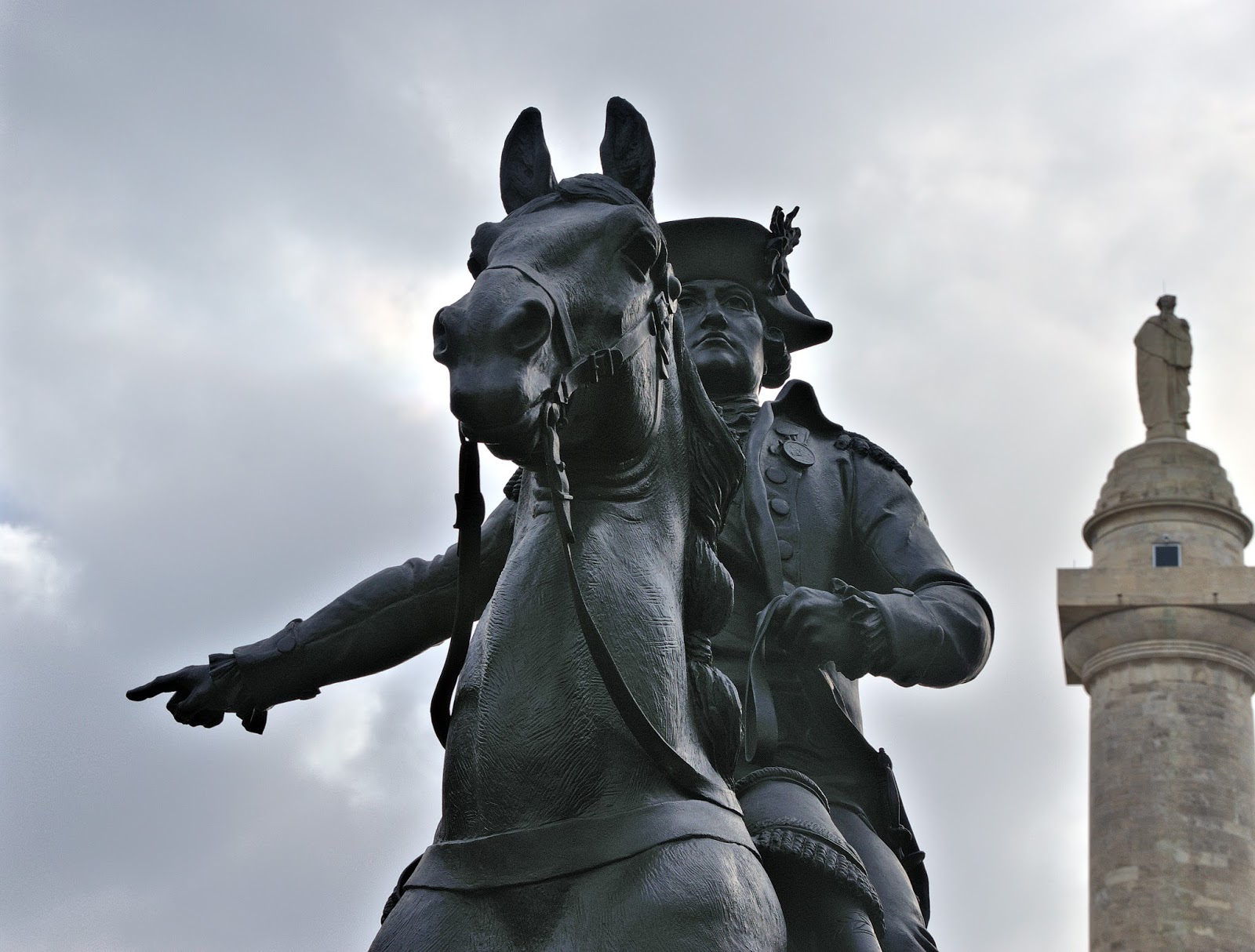
Born in Maryland, he saw action at White Plains as a captain, Germantown as a major, and at Camden, Cowpens, Guilford Court House, Hobkirk's Hill, Ninety Six and Eutaw Springs, holding the rank of Lieutenant Colonel. He was wounded at Eutaw Springs and unable to fight afterwards; following the war, he served as Maryland's governor from 1788-1791, and in the United States Senate from 1796 through 1803. His decisive bayonet charge at Cowpens was described by the commanding general, Daniel Morgan in this way: "[Howard's attack] was done with such address that the enemy fled with
the utmost precipitation…. We pushed our advantages so effectually, that
they never had an opportunity of rallying." As testament to his character and modesty, he not only declined President Washington's offer of Secretary of War, but also a commission as brigadier general in anticipation of war with France in 1798. He married Peggy Oswald Chew, daughter of the Chief Justice of the Pennsylvania Supreme Court; the Chew house was at the center of the fighting in Germantown.
Resources:
http://www.nps.gov/cowp/learn/historyculture/johneagerhoward.htm
http://msa.maryland.gov/megafile/msa/speccol/sc3500/sc3520/000600/000692/html/692bio2.html

