Sunday, December 25, 2016

Washington's Crossing 2016

I've been delinquent in posting, and since the last one, a tumultuous election occurred that provided an opportunity for consideration of what America was in the 18th Century and what it is now.  Leave it at that; one's answer to that question will flow directly from one's current assumptions and presumptions.  One thing that is consistent is the annual reenactment of the crossing of the Delaware River on Christmas Day, 1776.  The event takes on a kind of ritualism.  Still, it's a time for reflection. Credit goes to the reenactors as a cadre of near-clerics who keep alive the momentous nature of this event.  So without further comment, I'll share some of the images of the event today:

The Advance Party Lands


 First Boat Away


 One of Glover's Boatmen


Second Boat Away


 Washington's Boat


 The Commander in Chief


 Continental Army on the March

Wednesday, July 27, 2016

Shifting Alliances

The American Civil War is often portrayed as "brother against brother." The West Point class of 1846 yielded classmates Thomas J. "Stonewall" Jackson, Lieutenant General in the Confederate Army, and General George B. McClellan, Commanding General of the Union Army from 1861-62.  Similarly, during the French and Indian War, comrades and arms would face each other as enemies barely twenty years later.


Here is Braddock's Grave on Braddock's Road, not far from Fort Necessity.  British General Edward Braddock was mortally wounded at the Battle of the Monongahela about ten miles east of modern day Pittsburgh, in what is now known as Braddock, Pennsylvania.  The battle occurred on July 9, 1755.  Among the participants and members of Braddock's force were militia Colonel George Washington, Captain Horatio Gates, Lieutenant Colonel Thomas Gage, Captain Charles Lee and Captain William Mercer.  Washington, Gates, Lee and Mercer fought on the American side, and of course Gage on the British, during the Revolution.

As this is written, both Democrats and Republicans continue to engage in their respective civil wars, with former allies bitterly at odds.  It is always intriguing, in a watch the road accident sense, to contemplate betrayals.  People quite literally give their lives to others, and then become discarded when no longer needed or seen as liabilities.  

Sunday, July 24, 2016

Where It All Began

The American historian Francis Parkman wrote in 1897 of Jumonville that, "[j]udge it as we may, this obscure skirmish began the war that set the world on fire." The incident led to the French and Indian war in North America, and the Seven Years War as it was known in Europe, which in turn set the stage for the Revolutionary War as much as World War in set the stage for World War II.  Here is the scene:


George Washington had been sent to the region by Virginia's Royal Governor, Robert Dinwiddie, to advise French military personnel to leave.  After an initial such overture failed, Washington, now a Lieutenant Colonel in the militia, returned and allied with Indian chiefs Tanacharison and Monacatootha, and about 10 warriors.  Washington was accompanied by Captain Adam Sephen; between them, they had about 40 British soldiers.  They surprised Ensign Joseph Coulon de Villiers de Jumonville and his 31 soldiers camping here after prior negotiations failed.  The French were slaughtered, and Tanacharison bashed in the wounded Jumonville's skull.  The event set in motion the ensuing French and Indian War.

It is a remarkable place to stand and absorb what happened here, in this still preserved wildnerness niche.  Stephen and his men came over the ledge of rock, while Washington came from the left, and the Native Americans from the right, cutting off the French attempt at escape.


Thursday, July 7, 2016

The Boot

At Saratoga, at Breymann's Redoubt, Major General Benedict Arnold, holding no orders and otherwise laid aside by the commanding General Horatio Gates, facilitated the assault on this post, with Colonel Daniel Morgan and Major Henry Dearborn attacking head-on.  Arnold is generally credited for the assault on this redoubt (and suffering a shot to the leg) and turning the tide at this second battle at Saratoga, the Battle of Bemis Heights on October 7, 2016.  It was a victory that was obtained in violation of the commanding general's orders.  A plaque at the site consists solely of a boot.


His name is not mentioned on the monument,  National Park Service signage does note the "Arnold Monument." On the back, the soldier who put up the monument, had this inscribed:

 "Erected 1887 By
JOHN WATTS de PEYSTER
Brev: Maj: Gen: S.N.Y.
2nd V. Pres't Saratoga Mon't Ass't'n:
In memory of
the "most brilliant soldier" of the
Continental Army
who was desperately wounded
on this spot the sally port of
BORGOYNES GREAT WESTERN REDOUBT
7th October, 1777
winning for his countrymen
the decisive battle of the
American Revolution
and for himself the rank of

Major General."

As I looked at it, a father was explaining to his daughter what it meant.  She said that Arnold was a traitor.  Her father said that Arnold had done great things for the Revolution, and noted the victory here.  He referred to Arnold as "a maverick" and said sometimes you need that.

I don't defend Arnold's attempted sell-out of West Point or his later treachery and ferocious assaults in aid of the British in the latter part of the war, particularly in his home state of Connecticut, but it was interesting to hear this discussion in such a setting.


Monday, July 4, 2016

The First "Brexit"

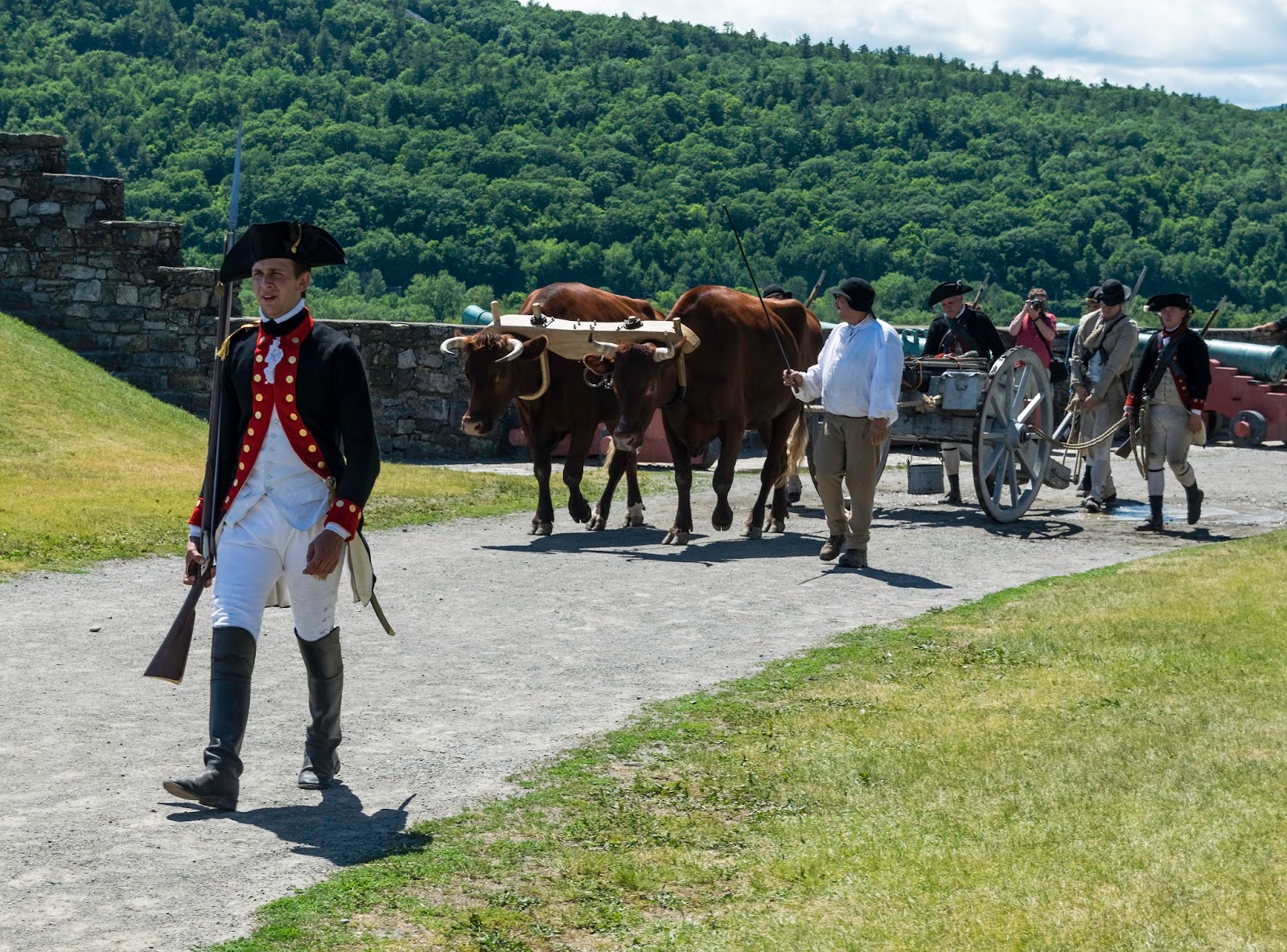
This July 4, 2016 weekend had particular resonance, as it followed by a week or two the monumental vote by the citizens of the United Kingdom to withdraw from the European Union.  I visited both Fort Ticonderoga and Saratoga, two well-preserved and important places for the first Brexit, the withdrawal of the American colonies from the United Kingdom.  Here is a scene from the reenactment activity at Fort Ticonderoga:


I thought of this connection, I must say, before I saw various columnists also drawing the analogy.  The American colonies were not in the same legal posture to the United Kingdom as the United Kingdom was to the EU, but nonetheless, there was a strong economic and sovereignty-related set of arguments.  A better analogy might be if Scotland withdraws from the United Kingdom.  It seems unlikely that the United Kingdom would send an army to retain Scotland, and indeed, the fact that a Scottish exit from the U.K. and return to the E.U. as an independent nation is being discussed as if it is within the realm of possibility.

The Brexit concept is broader and more profound than just this vote.  It is reflective of a different time and mindset in history.  Nations come and go and come again; witness Poland, which literally vanished for a bit as an independent nation. 

Of equal import are the discussions of so-called "Texit," with Texas withdrawing from the United States.  In 1861, an American president sent troops on a four-year campaign to prevent secession.  Would such happen today? Granted, the EU charter provides for such an eventuality within the EU; the American Constitution does not address secession.  However, There is hundred year old Supreme Court authority ruling that a state may not secede from the United States (see Texas v. White, 74 U.S. 700 (1869)).

The King and Parliament no doubt thought the law precluded American independence.  The Declaration of Independence was at odds with that and, if read literally and in its essence, would also be at odds with those who find permanence to political boundaries drawn long ago.

Saturday, June 25, 2016

The Minuteman, Elizabeth and the Battle of Springfield

Apologies for the delay between posts.  This one notes the Minuteman monument in Elizabeth, New Jersey, shown below:


The Battle of Springfield, whose anniversary is this month, took place on June 23, 1780.  A British and Hessian force of some 6,000 under  Lieutenant General Wilhelm, Baron von Knyphausen landed at Elizabethport, seeking to attack Washington's army in northern New Jersey.  This area of Elizabeth, on Elizabeth Avenue at what is now Union Square, was the opening salvo.  A small contingent of minuteman were involved, and the British and Hessians moved in two columns through Connecticut Farms (now Union Township) where the British and Hessians were delayed, but victorious on June 7. They continued on towards Springfield, where they were forced to retreat.

Although the prime effort of the British was in the Carolinas at this point, had this attack succeeded for the British, it could have had a far more significant impact on war.  It failed, and has been relegated to not much more than a footnote in histories of the war, but the argument may be made that its importance has been understated.

In the context of today's Elizabeth, this seemingly incongruous monument is a vivid reminder of the importance of this battle and the close calls that often marked the activity in the Revolution.

Monday, April 18, 2016

Lexington and Concord and the Rule of Law

April 19, 1775:the confrontation of the Regulars with the militia at Lexington Green.  Today we see the markers that show the line in which Captain John Parker's men stood:


We are still over a year from the Declaration of Independence, so at this time both Parker's company were as British as the Regulars they confronted.  Firing on the Regulars would have been an act of treason.  After the first shot--which remains unresolved as to who fired it--eight Americans died and ten were wounded.  

 After the battles, the political battle began.  The "Americans" gathered "depositions," at the time sworn statements, including this one by Sylvanus Wood, 23, reaches us across the centuries: "[t]he British troops approached us rapidly in platoons, with a General officer on horse-back at their head. The officer came up to within about two rods of the centre of the company, where I stood.--The first platoon being about three rods distant. They there halted. The officer then swung his sword, and said, 'Lay down your arms, you damn'd rebels, or you are all dead men--fire.' Some guns were fired by the British at us from the first platoon, but no person was killed or hurt, being probably charged only with powder. Just at this time, Captain Parker ordered every man to take care of himself. The company immediately dispersed; and while the company was dispersing and leaping over the wall, the second platoon of the British fired, and killed some of our men. There was not a gun fired by any of Captain Parker's company within my knowledge."

A case is made for self defense. 

British Lieutenant John Barker, also present, disagreed: "At 5 o’clock we arrived there and saw a number of people, I believe 2 and 3 hundred, formed on a common in the middle of the town; we still continued advancing, keeping prepared against an attack tho’ without intending to attack them, but on our coming near them they fired on or two shots, upon which our men without any orders rushed in upon them, fired and put ‘em to flight; several of them were killed, we could not tell how many because they were got behind walls and into the woods; We had a man of the 10th Light Infantry wounded, nobody else hurt. We then formed upon the common but with some difficulty, the men were so wild they could hear no orders; we waited a considerable time there and at length proceeded on our way to Concord, which we then learnt was our destination, in order to destroy a magazine of stores collected there."

One wonders what circumstances today would be such as occur "in the course of human events" that would justify, as a matter of law, a 21st century Lexington.

Saturday, March 26, 2016

Spain and the American Revolution

Most people think only of France when they think of American allies during the Revolutionary War.  Some may recall the contributions of individual military officers, such as Von Steuben or Pulaski, and think of other countries.  Often overlooked, though, was the contribution of Spain to the American cause.

In a small park in the middle of downtown Philadelphia stands a statue of Don Diego de Gardoqui, who became Spain's first ambassador to the United States.


Born in 1735, he was a Spanish businessman in a successful family business.  He served as a financial intermediary for Spain with the Americans, interacting with John Jay.  Through him, Spain supplied significant arms and munitions.  He died in 1798.

In a letter to Gardoqui after the war, dated January 20, 1786 from Mount Vernon, George Washington noted Gardoqui as one "whose good wishes were early engaged in the American cause, and who has attended to its progress thro' the various stages of the revolution."

Sunday, February 14, 2016

Colonel John Eager Howard

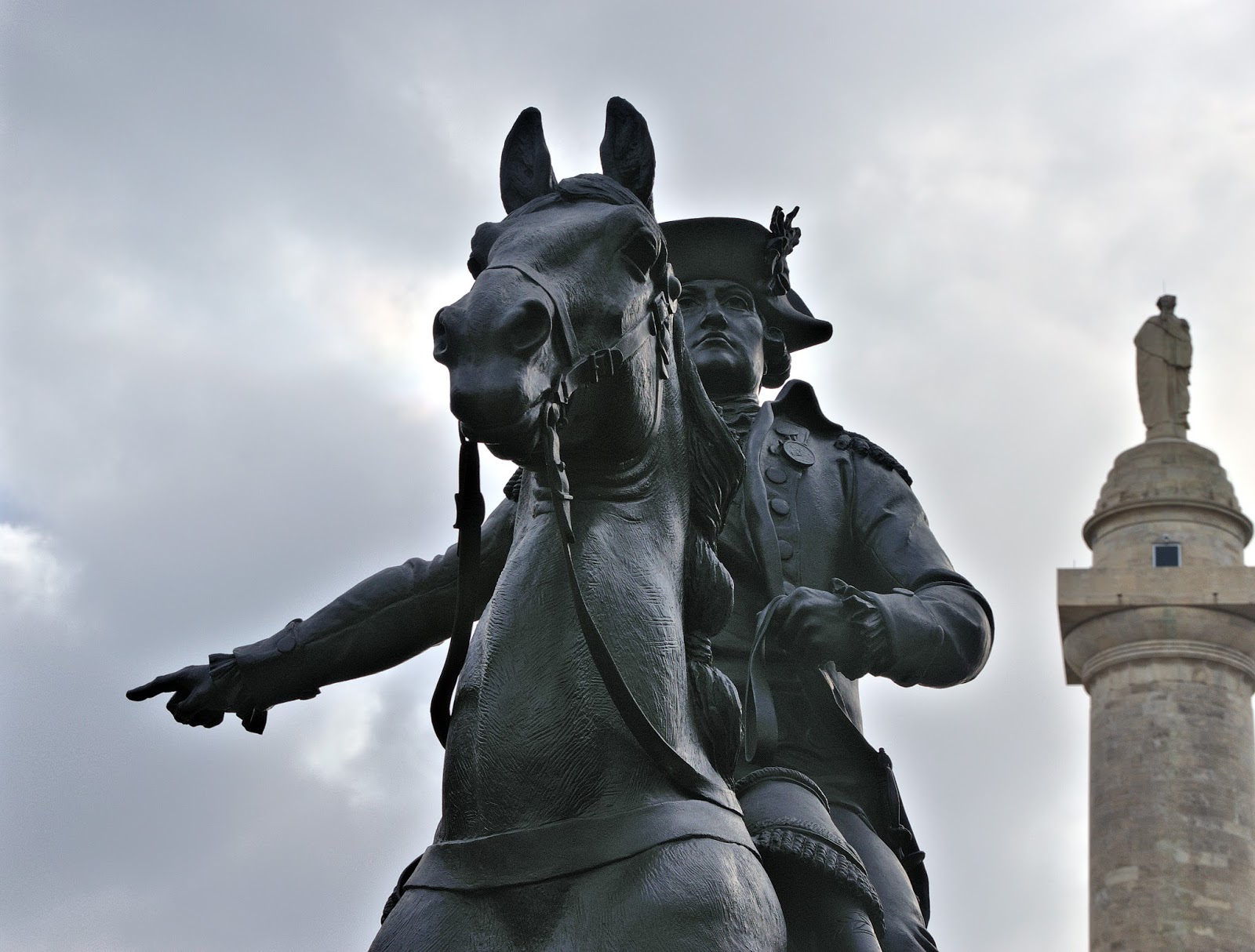
As much as I read and have read about the American Revolution, I am always struck by finding not only reference to, but statuary about, American military leaders below the rank of general in the war that barely penetrate the awareness of the contemporary American and yet were critical to the outcome of that war.  One example is Colonel John Eager Howard, perhaps most well known in Maryland but whose contributions were vastly important to that effort.  His equestrian statue is in the Mount Vernon Place in Baltimore, in the same park as the Washington Monument.


Born in Maryland, he saw action at White Plains as a captain, Germantown as a major, and at Camden, Cowpens, Guilford Court House, Hobkirk's Hill, Ninety Six and Eutaw Springs, holding the rank of Lieutenant Colonel.  He was wounded at Eutaw Springs and unable to fight afterwards; following the war, he served as Maryland's governor from 1788-1791, and in the United States Senate from 1796 through 1803.  His decisive bayonet charge at Cowpens was described by the commanding general, Daniel Morgan in this way: "[Howard's attack] was done with such address that the enemy fled with the utmost precipitation…. We pushed our advantages so effectually, that they never had an opportunity of rallying." As testament to his character and modesty, he not only declined President Washington's offer of Secretary of War, but also a commission as brigadier general in anticipation of war with France in 1798.  He married Peggy Oswald Chew, daughter of the Chief Justice of the Pennsylvania Supreme Court; the Chew house was at the center of the fighting in Germantown.

Resources:

http://www.nps.gov/cowp/learn/historyculture/johneagerhoward.htm

http://bioguide.congress.gov/scripts/biodisplay.pl?index=H000841

http://msa.maryland.gov/megafile/msa/speccol/sc3500/sc3520/000600/000692/html/692bio2.html


Sunday, January 31, 2016

Earthworks

This month is the 240th anniversary of the Battle of Moore's Creek, fought February 27, 1776. British strategy in late 1775 and early 1776 focused on the Southern theater, and representations like those from the bizarre and somewhat delusional Loyalist Governor Josiah Martin fed the British illusion that the populace would rise up and oppose the "rebels." Martin assembled a force of Regulators (a group that during the 1760s had risen up against corrupt local officials, but had deteriorated into a kind of vigilante group), as well as Loyalists and British soldiers.  He sought and obtained permission to place the Scotsman Donald McDonald in charge, with a commission as Brigadier-General.

General James Moore, in command of the 1st North Carolina Regiment,had fought for the Royalist government against the Regulators.  Reinforcements under Colonel Alexander Lillington and others joined him.  Moore's back was to the river, and McDonald saw strategic advantage to attacking him in that position.  Following some maneuvering, by February 26, 1776, the forces found themselves on opposite sides of the Moore's Creek Bridge.  Lillington established earthwork defenses, set up two pieces of artillery and removed a plank from the bridge.  Colonel Richard Caswell reinforced Lillington.

The earthworks formed a semicircle around the bridge on the American side of Moore's Creek and are shown here:


There are various battlefield sites that still have the earthworks preserved. This is remarkable, given the inevitable effect of weather, animals, natural erosion and human traffic in these areas. We are one step removed from those who built these parapets and ditches: their hands on tools, their feet on this ground, their eyes looking over the same defenses we look over. So far in our travels we have not quite encountered this. But as we walk around, and take in the swamp, the woods, the bridge, and as we stand in the same defensive posture as the Americans or come across the bridge as the Loyalists, we can begin to comprehend the courage of those who fought in this war--on both sides.

Tuesday, January 5, 2016

Edgar Allan Poe and the Revolution

On a recent excursion to Baltimore and visit to Edgar Allan Poe's grave at Westminster Hall and Burial Ground, I noticed that his grandfather, David Poe, Sr., was also buried there.  Nearby was the original burial spot of his grandson, Edgar Allan Poe.


The senior Poe was born in 1743 in Londonderry, Northern Ireland.  He served as a major in the Continental Army and was Assistant Deputy-Quartermaster general for Baltimore (though at least one source calls this an honorary position).  Sources also claim he donated $40,000 of his own money to the cause.  Lafayette knew David Poe (they are reported to have fought together) and visited his grave on a visit to Baltimore.  In his early biography of Edgar Allan Poe, James Albert Harrison refers to David Poe as a general (possibly because of the quartermaster role) and "devoted friend of Lafayette).  Edgar Allan Poe also met Lafayette.  As for his own military record, Edgar Allan Poe attended West Point but was court-martialed and was dismissed in 1831.  Still, the connection to Lafayette brings Edgar Allan Poe to within one degree of separation to George Washington.


Tuesday, December 15, 2015

John Paul Jones and Political Correctness

At Annapolis, the corporal remains of John Paul Jones are in a crypt that compares with that of Napoleon in Paris and Ulysses S. Grant in New York:


According to the Naval Academy website, "John Paul Jones has been lauded since 1775 as the Father of the US Navy.  His influence and leadership were foundational in the establishment of our Navy and in many ways the success of our War of Independence." On the other hand, some argue that Commodore John Barry was the real "father" of the American Navy.  (These two schools of thought ignore the role of Benedict Arnold at Valcour Island, and his naval heroics, but that is for another day).  For a discussion of the relative merits of the claim between Barry and Jones, see http://www.usni.org/magazines/navalhistory/2013-07/two-captains-breakfast.

By today's standards, Jones's reputation in retrospect might be subject to question.  He served on two slave ships, for a couple of years, finally leaving it--but he did voluntarily participate as an officer on those ships.  Evan Thomas, in John Paul Jones: Sailor, Hero, Father of the American Navy, wrote that "John Paul sailed the infamous 'middle passage' between Africa and the slave plantations of the Caribbean," worked on slave ships for about three years.  Apart from that, he was charged with murder, but acquitted.  He killed another man while in command of a commercial ship in the West Indies.  His heralded victory while in command of the Bonhomme Richard against the Serapis nonetheless cost half his crew dead or wounded.  A summary of his life is on the website for the John Paul Jones Museum in Scotland, see http://www.jpj.demon.co.uk/.  Among the better biographies is Samuel Eliot Morrison, John Paul Jones: A Sailor's Biography.

Should Jones be de-heroicized? Did he redeem by leaving the trade? Was three years too much to forgive? He made money as a slaver, even if he did purportedly leave the trade due to developing a distaste for it.  There is a memorial to Confederate soldiers in Bolton Hill in Baltimore that has a sign on it asking for comment as to whether it should be taken down.  Is the crypt at Annapolis next?


Thursday, December 10, 2015

Samuel Smith and the Call of Duty

On Federal Hill in Baltimore stands a statue of Samuel Smith.  Smith, who lived into his late eighties, served in both the American Revolution, rising to the rank of Lieutenant Colonel, and then in the War of 1812, leaving the service as a major-general.


Smith was only 24 years old when General George Washington put him in charge of Fort Mifflin on the Philadelphia side of the Delaware River in the fall of 1777.  The bombardment of Fort Mifflin was terrible, among the worst of the war, and ultimately, in November, Smith had to abandon the fort.  He had fought at New York and White Plains, and also Brandywine and Monmouth.  He served in both the Senate and the House of Representatives of the new country, as well as mayor of Baltimore, which he defended against the British during the invasion in the War of 1812.


Sunday, December 6, 2015

Baron Johann de Kalb and Nationality

Baron Johann de Kalb is one of the more intriguing "foreigners" who came to the nascent American nation to join the Patriot (American) forces in the Revolutionary War.  Born in Germany, he was trained by the French and came to America to assess Colonial attitudes towards the British.  Through the intervention of Benjamin Franklin and Lafayette, De Kalb came over with Lafayette in spring 1777 and in September, was appointed a major-general by the Continental Congress.  In command  of the Maryland and Delaware units of the Continental Army, he was mortally wounded at the Battle of Camden in South Carolina on August 16, 1780 and died of his wounds three days later.


He is honored by a statue on the grounds of the Maryland Statehouse in Annapolis, Maryland; the statue was erected in 1866.  Maryland claims his as its own based on his service with the Maryland line in the Revolution.  A plaque at the site claims de Kalb purportedly stated "I die the death I always prayed for: the death of a soldier fighting for the rights of man."

It is worth reflecting on de Kalb and his community of nationalities and loyalties as we ponder current immigration issues.  Here was a German, trained by and in service to the French, and died leading Americans into battle against the British.

Tuesday, October 27, 2015

The American Occupation of Montreal

American General Richard Montgomery took Montreal on November 13, 1775.  One of the remaining landmarks of that time is Chateau Ramezay, finished in 1705, shown here:


The American forces used the Chateau as their headquarters in 1775.  The taking of Montreal was prelude to the assault on Quebec City. Two months earlier, on September 25, 1775, at the Battle of Longue-Pointe, Ethan Allen failed in his attempt to take the city.

It was all for naught.  Montgomery met up with Benedict Arnold outside Quebec City; Montgomery was killed in the assault and Arnold seriously wounded.  Although capturing Canada remained in the mind of Washington and others, it was an ill-assumed premise that proved costly and, if anything, further united the Canadians against the Americans.

Monday, September 28, 2015

Siege of Charleston 1780

In the spring of 1780 through Guilford Courthouse in spring 1781, General Cornwallis' objective was to destroy the American army in the South, and the American plan was to harry the British, distract and essentially bleed them to death and, if possible, engage them decisively.  The British began well here, in Charleston, but their numbers would diminish through attrition whereas the Americans had seemingly endless men from which to draw.  Matters were not helped by Clinton's take it or leave it declaration on his departure from South Carolina for New York, pushing otherwise neutral persons as much towards the American as the British side, and escalating the bloody civil war in South Carolina.

Having failed early in the war to take Charleston under General Clinton, his second effort was successful.  The British fleet and troops arrived on February 10, 1780.  Together with and Lord Rawdon, he commanded 14,000 men and 90 ships.  General Benjamin Lincoln commanded 5,000 men.  Following a siege of about six weeks, Lincoln surrendered.  Here is Marion Square, where Lincoln surrendered.


The plaque tells us: "The British capture of Charleston in May 1780 was one of the worst defeats of the Revolution.  On March 30-31 Gen. Henry Clinton's British, Hessian, and Loyalist force crossed the Ashley River north of Charleston.  On April 1, Clinton advanced against the American defenses near this site, held by Gen. Benjamin Lincoln's Continentals and militia.  The 42-day siege would be the longest of the war. As Gen. Charles Cornwallis closed off Lincoln's escape routes on the Cooper River, Clinton advanced his siege lines and bombarded Charleston.  On May 12, 1780, in front of the American works near this spot, Lincoln surrendered the city and his force of 6,000 men, after what one British officer called "a gallant defense." The British occupied Charleston for more than 2 1/2 years, evacuating Dec. 14, 1782." Astute observers will recall that Yorktown was taken on  October 19, 1781, so for over a year, the British remained in control of the city.

People often think of Yorktown as the end of the war.  Cornwallis surrendered 8,000 soldiers.  Recall that the Americans surrendered some 2,800 soldiers at Fort Washington, New York, early in the war.  In Charleston, we are struck by just how little traditional military victories actually mattered in the end to the political solution.

Saturday, September 26, 2015

Bennington, Stark and Warner

The Battle of Bennington, on August 16, 1777, occurred in Hoosick, New York, although the storehouse that was the subject of the raid was just across the border in the recently "independent" Vermont.  Burgoyne was advancing on Albany, and by early August 1777 Burgoyne knew Howe was not moving northward to meet up with him.  Burgoyne needed supplies.  He sent a predominantly Hessian force, with Indian components, led by Colonel Friedrich Baum to procure the supplies.  Burgoyne's intelligence was flawed, and he was unaware that Colonel John Stark had become Major General John Stark, and had nearly 1500 militia at Bennington.

The hilltop where the battle occurred gives a real sense of why the Hessians thought they had a defensible position, and what the Americans had to overcome.  This is a view looking north


The American victory Bennington was significant because it further weakened Burgoyne's already finite force; he lost 15% of his men at Bennington.  Beyond this, of course, was the failure to obtain the necessary supplies.  He continued to move deeper into hostile territory, and into the cataclysm that was Saratoga. 

Bennington is the story of two of the great commanders of the Revolution, John Stark and Seth Warner.  Both were veterans of prior battles, and fought throughout the Revolution.  Warner never made general; he ended his career as a colonel and died in 1784 at the age of 41 in poverty. 

The battles of the Revolution, unlike those of the American Civil War, generally had far fewer casualties, and yet the stakes were certainly as high as in any war.  These small battles and these small victories resonated far beyond their superficial aspects.  Burgoyne sent this force to obtain supplies for his main force that was suffering from attrition.  The effort not only failed, but further depleted Burgoynes' forces.  To whatever measurable extent this depletion affected the result at the battles of Freeman's Farm and Bemis Heights, collectively known as the Battle of Saratoga, the efforts of Stark and Warner contributed not only to that victory, but also to the consequential decision of the French to formally enter the war.  

Saturday, September 19, 2015

The Battle of Johnstown

The Battle of Johnstown was among the last of the major land battles in the northern theater of the Revolution, and occurring on October 25, 1781, together with the American-French victory at Yorktown on October 19, 1781, essentially ended the real military action of the war.  Here is a segment of the battlefield as marked just north of the Johnstown Hall, itself a few miles from downtown Johnstown.


Together with Major John Ross, Colonel Marinus Willett led over 400 militia against a combined enemy force of over 700 Regulars, Iroquois and Rangers under Major John Ross and Captain Walter Butler.  At this point in the war, the Mohawk Valley was the scene of raids with more of an in terrorem purpose than seizure of land or military advantage.  Although often portrayed as an American victory, it may well have been darkness that saved the Americans and caused the British to withdraw for strategic reasons.  Howard Peckham reports 13 Americans killed, 23 wounded and 5 missing, with the British side incurring 7 killed, some 40 wounded and 50 missing.  

Sunday, September 6, 2015

Stone Arabia and the Emptiness of Death

     On October 19, 1780, one of the more brutal battles in the war in the Mohawk Valley in New York State occurred here, at Stone Arabia.


     The Mohawk Valley is a beautiful, haunting place.  I've been through there a few times in photographing Revolutionary War sites for my book.  On this day I had been to Johnstown and the remarkable spot of Fort Plain.  From that hill, exhibits point you to the many battles, like this one, that were part of the combined British/Loyalist/Indian raids on towns in the region.  The British success here at Stone Arabia preceded the defeat of the British at Klock's field later in the day.  Meanwhile Colonel John Brown, veteran of Ticonderoga and the Quebec campaign, was killed here as he and his force faced overwhelming numbers.  He was 36 years old.  The British burned the town of Stone Arabia.  A year later the Americans were victorious at the Battle of Johnstown, coinciding with the British surrender at Yorktown, and the war essentially ended, although it sputtered on for two more years.

     There is no easy place to park apart from the dirt "shoulder" on the road, being careful not to slide into the ditch.  It is also hard to image the brutal nature of the fight in looking at this placid landscape.  Brown was another of those virtually unknown officers of the Revolution who fought up and down the East Coast, and dying in these fields in skirmishes, raids and battles that ultimately proved so meaningless to the end result.  The raids in the Mohawk Valley essentially ended with Johnstown, but the major action in the war had long since shifted to the South.  One cannot help but think of those who are dying in Iraq or Afghanistan as part of hit and run raids that to not ultimately affect the result in a war, but nonetheless remain part of its brutality.


Thursday, August 6, 2015

Revolutionary War Afterlife

It is sometimes remarkable to consider how much certain Revolutionary War generals compressed into relatively brief lives.  One such example is General "Mad Anthony" Wayne. Wayne lived just under 52 years, born January 1, 1745 and died December 15, 1796.  At thirty-one, he was a colonel in the 4th Pennsylvania Regiment of the Continental Army, participating in the ill-fated invasion of Canada in 1776.   Just turning thirty-two, he became a brigadier-general in the Continental Army. Among his successes was the taking of the British fort at Stony Point, New York, employing a comparable night attack such as that used by British General Charles Grey against Wayne at Paoli, Pennsylvania.  In the last year of the war (1783) he became a major general.

After the war, Wayne spent eight years in politics as an officeholder, and was recalled to service by President George Washington to take charge of the American war effort in the northwest territories where Native American tribes, aided and abetted by the British, continued to resist American annexation of territory ceded by the British.  With the Treaty of Greenville, signed August 3, 1795, the fifty-year old Wayne then spent the next year back at the frontier stabilizing the territory.  On July 11, 1796 the British finally surrendered the region and a month later, Wayne County (then including not only Michigan, but other states) was established and named in his honor.  A plaque in Detroit today marks the event. 


Wayne died a few months later of gout.