Showing posts with label Benedict Arnold. Show all posts

Thursday, July 7, 2016

The Boot

At Saratoga, at Breymann's Redoubt, Major General Benedict Arnold, holding no orders and otherwise laid aside by the commanding General Horatio Gates, facilitated the assault on this post, with Colonel Daniel Morgan and Major Henry Dearborn attacking head-on.  Arnold is generally credited for the assault on this redoubt (and suffering a shot to the leg) and turning the tide at this second battle at Saratoga, the Battle of Bemis Heights on October 7, 2016.  It was a victory that was obtained in violation of the commanding general's orders.  A plaque at the site consists solely of a boot.


His name is not mentioned on the monument,  National Park Service signage does note the "Arnold Monument." On the back, the soldier who put up the monument, had this inscribed:

 "Erected 1887 By
JOHN WATTS de PEYSTER
Brev: Maj: Gen: S.N.Y.
2nd V. Pres't Saratoga Mon't Ass't'n:
In memory of
the "most brilliant soldier" of the
Continental Army
who was desperately wounded
on this spot the sally port of
BORGOYNES GREAT WESTERN REDOUBT
7th October, 1777
winning for his countrymen
the decisive battle of the
American Revolution
and for himself the rank of

Major General."

As I looked at it, a father was explaining to his daughter what it meant.  She said that Arnold was a traitor.  Her father said that Arnold had done great things for the Revolution, and noted the victory here.  He referred to Arnold as "a maverick" and said sometimes you need that.

I don't defend Arnold's attempted sell-out of West Point or his later treachery and ferocious assaults in aid of the British in the latter part of the war, particularly in his home state of Connecticut, but it was interesting to hear this discussion in such a setting.


Saturday, July 4, 2015

Battle of Richmond

     The Battle of Richmond on Jul 5, 1781 was more of a raid, much as the battles in Connecticut, in which an overwhelming British force entered the city, dispersed token resistance, burned buildings, and left.  Still, it is important to note this exchange in terms of the overall activities in the South at this time and as a tile in the mosaic of Benedict Arnold's new career as a British general.

     The British had a finite number of troops in the South, and had just suffered significant losses of favorable militia at King's Mountain.  Contrary to hopes, if not expectations, Cornwallis was not generating additional enlistments among the local population.  King's Mountain had not helped.  Clinton sent Benedict Arnold down from New York in December 1780 with 1600 troops, which included Lieutenant Colonel John Simcoe's Queens Rangers and Major General Thomas Dundas' 18th British Regiment (Scotch).  On January 4, they landed about 25 miles south of Richmond and marched on the city, taking position on January 5.

     American Colonel John Nichols set up with 200 Virginia militia on Church Hill to the east of the center of the city.  Church Hill is the site of St. John's Church, where Patrick Henry had delivered his famous "Give me liberty or give me death" speech.  Here is that location:


     The Americans withdraw with no casualties as the British advanced.  Arnold burned parts of the city and withdrew.

     As in Connecticut, this was less of a strategic operation than what today we might term a kind of terrorist attack.  It was hit and run and accomplished nothing militarily.  Given the events occurring that year in the Southern campaign and the result at Yorktown, it was not even a distraction.
   

Saturday, October 4, 2014

Valcour Island, The Philadelphia, and the Artifacts of History

I previously posted on the Battle of Valcour Island.  This past week I had to be in Washington, DC for a meeting at 11, a few minutes from the Smithsonian American History Museum.  I dropped in and found the recovered Philadelphia, one of the gondolas that was part of the Patriot "fleet" opposing the British under Guy Carleton.  Here is a front view:


In Benedict Arnold's Navy, James L. Nelson described these gondolas "essentially large, open boats, sharp at the bow and stern, farmed and planed with white oak," and "propelled by oars or by a square mainsail and topsail set on a single mast." John R. Bratten, in The Gondola Philadelphia and the Battle of Lake Champlain, notes they were called by various names: gundaloes, gundalows, gun'low, gondela, gundalow, gundaloa gundeloe and gunlo.

Captain Benjamin Rue and sixteen of his crew saved themselves and reached Fort Ticonderoga in safety. 

The Philadelphia was recovered in the 1930s and you can see the cannonball that finally sank it on the bottom left square of the photograph, according to the sign.  Nelson notes that The Philadelphia "was the only American vessel lost, though all the fleet had been severely mauled." 

It is extraordinary that we can look at this vessel, with so much of it intact, and be just one step removed from that momentous event.


Sunday, August 31, 2014

Valcour Island and the Lessons of History

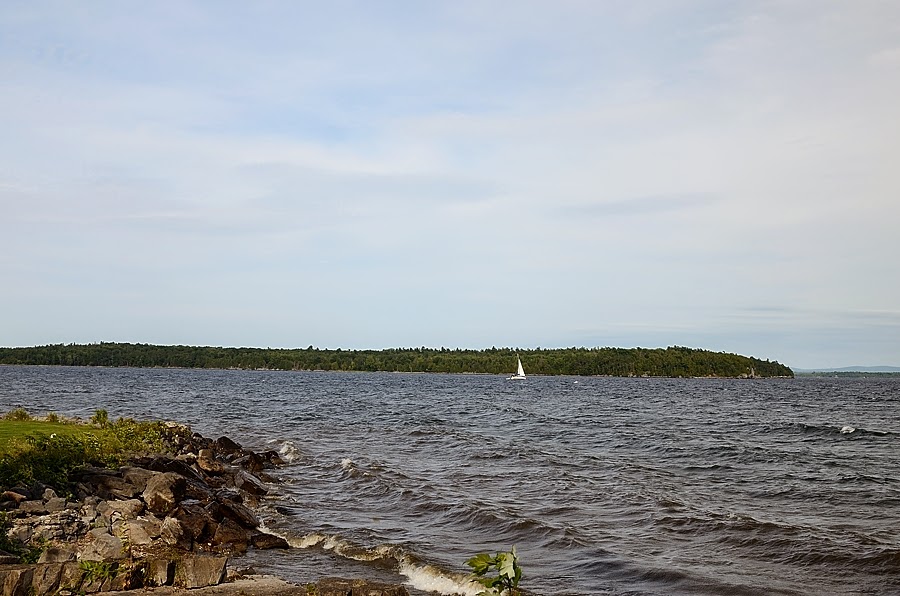
It is easy to see Valcour Island from the boat launch at Peru, New York, and from the campus of Clinton County Community College at Bluff's Point, but not from the vicinity of the New York State Marker along Route 9 that purports to identify the area of the action.  There is a conference center there (private property).  One wold think that such an important battle would not only not be so generally ignored in discussions of the war for the lay person, but would also have a small dedicated parking and viewing area by the roadside.

Anyway, here's a view of the strait near the sign that shows the vicinity of the battle.


There are those who credit Benedict Arnold with creating and commanding America's first navy.  It was here, in the straight between the New York mainland (shown in foreground) and Valcour Island (showing the island to its southern tip) that, on October 11, 1776, Arnold stopped the pursuit of Guy Carleton, commander-in-chief of the British forces in Canada, following Arnold's withdrawal from the siege of Quebec in spring 1776.

The only other plaque I found apart from the one by Route 9 was at Bluff's Point.  We should always recall the words of George Santayana that "Those who cannot remember the past are condemned to repeat it," although Edmund Burke far more contemporaneous to the Revolution, also reportedly said, “Those who don't know history are doomed to repeat it.” The war might well have been crushed before it began but for Arnold's determined and heroic stand in these waters, yet you could not tell it from the minimal coverage here. 

Saturday, January 26, 2013

Groton Heights and Benedict Arnold's Revenge

After the discovery of his plot to hand over West Point to the British, Benedict Arnold became a brigadier general in the British army.  On September 6, 1781, while the war raged savagely in the Carolinas and Cornwallis headed for his doom at Yorktown, Arnold launched his own fierce and brutal raid on his home colony, Connecticut.  The Thames River divided New London on the western bank from Groton on the eastern.  Fort Trumbull, south of New London, was sparsely defended and abandoned after one volley and the spiking of its guns.  lieutenant Colonel William Ledyard, a native of Groton, commanded Fort Griswold on the Groton side.  He was outnumbered, 800 to 150.  The British force of Regulars, Hessians and Loyalist forces were led by Lieutenant Colonel Edmund Eyre. The Americans vowing to defend the fort to the last extremity, and the British assaulted.  British Major William Montgomery led an attack from the north, and was killed; when Ledyard offered his sword in surrender, he was also killed and the massacre of American troops began.


Here we see a view inside the fort.  The enclosure on the left is where Ledyard fell.  On the right, next to the tree, is the plaque indicating where Montgomery fell.  This is a remarkable place in that it gives a sense of the claustrophobic nature of the Revolutionary War battlefield.

Tuesday, January 1, 2013

Memorializing John Andre

On this cold, damp New Year's Day, 2013, I journeyed to Rivervale, New Jersey, and photographed the site of the Baylor Massacre, to be noted in later posts.  A few miles away, though, is the monument to John Andre and the site where he was hanged.  It was one of those moments where you are fully conversant with place, history and what happened on the very spot.


We are at the top of the hill, looking toward Tappan Road, just over the border from New Jersey, in New York.  Andre was the British officer with whom Benedict Arnold corresponded.  Upon discovery of the treason to the American cause, Andre was captured through a strange and at times comic set of circumstances.  He was tried nearby in an inn in Tappan.  He asked Washington for death by firing squad, as a soldier, but instead was hanged as a spy.  His last words reportedly were: "I pray you to bear me witness that I meet my fate like a brave man." He was buried here but in 1821, his remains were removed to Westminster Abbey, in London.

Washington called him "an accomplished man and gallant officer." It is something to think about that we have homage to a man who participated in one of the greatest treasons of the Revolution, and not merely mark the site of his hanging, but give it monumental status, and on the Saratoga battlefield, the monument to Benedict Arnold is a boot (for his wounded leg) but does not mention him by name.

Wednesday, October 17, 2012

Saratoga and "Best Measures"

In the last post I commented on the relatively genteel manner in which the commanding officers at Saratoga dined and toasted each other, while many had died or been wounded on the battlefield at Saratoga.  The first  action occurred here, at Freeman's Farm, on September 19, 1777.  It was a scene of frenzied actions, of back and forth across the battlefield, exemplified by Benedict Arnold's wild courage.


But it was also marked by a quieter kind of courage and duty, shown by Hessian commander Baron von Riedesel.  Riedesel's memoirs, apparently describing the action in the third person, note that "About 1 o'clock, a brisk cannonade and fire of musketry was heard, and general Riedesel presumed that general Burgoyne's column was then engaged with the enemy.  The fire again commenced towards 3 o'clock, and became much hotter.  General Riedesel finding himself without any intelligence from general Burgoyne, despatched captain Willoe to him.  This officer returned in about three quarters of an hour, and brought orders to general Riedesel to take the best measures to preserve the artillery, baggage and batteaux, and to repair immediately afterwards to general Burgoyne's relief, with as many troops as he should be able to take along, and to attempt an attack on the right flank of the enemy."

I like this excerpt; written by Riedesel in the third person, it provides an aura of detachment and objectivity.  I particularly like the part about Riedesel not knowing what is going on, and spending forty-five minutes until orders return from Willoe, telling him to take "best measures." One imagines Willoe tearing back and forth along this battlefield, finding Burgoyne, expressing Riedesel's concerns, getting instructions, and racing back.  No cell phones, no radios, no "walkie talkies"--communication the old fashioned way.  And reliance on the human being in the field, in life and death circumstances, to take "best measures."


Sunday, September 2, 2012

Ridgefield, Danbury and the Sacrifice of Old Men

On April 27, 1777, 67-year old General David Wooster was mortally wounded just outside the center of Ridgefield, Connecticut, leading the second of three assaults against a 2000-man British force led by New York's royalist governor, William Tryon.  Also leading the Connecticut militia forces were Benedict Arnold and Gold Silliman.
Here is the spot, looking toward Ridgefield, where Wooster fell.  Born in 1710, Wooster enlisted in the militia in 1739 during the war between England and Spain, fought at the Siege of Louisbourg during King George's War, and fought at Carillon during the French and Indian War.  He was put in charge of Montreal and American forces in Quebec, where he was charged with incompetence, acquitted by court martial, and returned to Connecticut to take command of the militia.  He was seven years older than Israel Putnam, another of the Revolution's old men,and if not the, then certainly one of the oldest American general to die in the field in the Revolution.