Showing posts with label New York. Show all posts

Saturday, May 16, 2015

Nathan Hale's Last Words

On Vanderbilt Avenue across from Grand Central Station at the corner of East 44th Street, a block from the Yale Club, is this plaque, that tells us "At the British Artillery Park near this site Nathan Hale captain in the U.S. Army, Yale graduate of 1773, apprehended within enemy lines while seeking information, was executed on the morning of September 22, 1776.  His last words were 'I only regret that I have but one life to lose for my country.'"


Another plaque on 3rd Avenue and 65th Street tells us that he was hanged "probably within 100 yards" of that spot.

The first plaque that I have pictured was put up by the Mary Washington Colonial Chapter, D.A.R., and the Yale Club of New York.  The second one was erected by the New York Historical Society.

Not only is the actual place of his hanging disputed, but the actual utterance (if any) of what he said is also disputed and quoted differently.

I am less interested in running to ground the various arguments, but rather, like Plymouth Rock, suggest that the iconography, at least in this case, is important.  Whether at this spot or 65th Street, we know the location was within these 20-30 blocks of Manhattan.  And whether he said certain specific words or not, the story has emerged that he did make a rather heroic statement in extreme (and final) circumstances.  We build a national culture on such things, and some things remain valuable as leaps of faith.

Sunday, August 31, 2014

Valcour Island and the Lessons of History

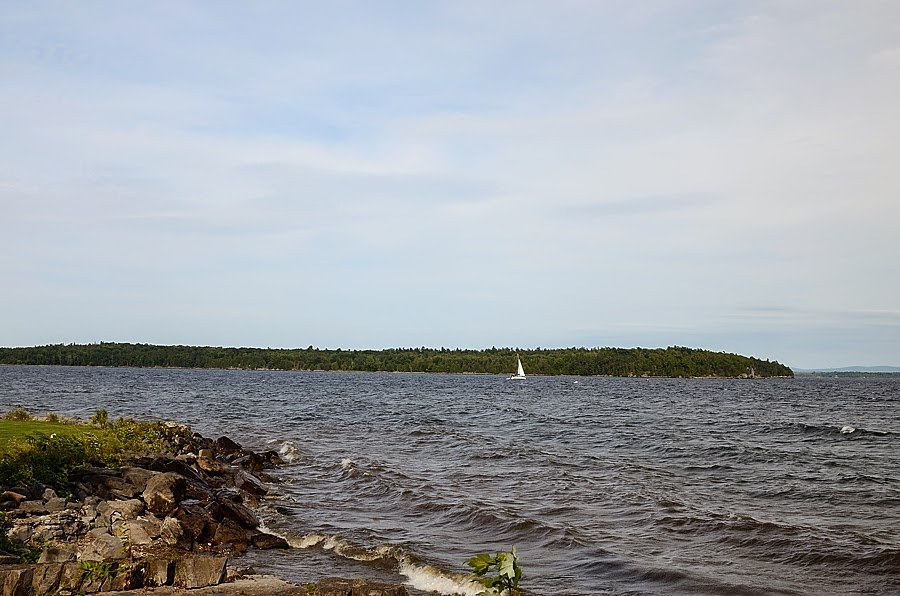
It is easy to see Valcour Island from the boat launch at Peru, New York, and from the campus of Clinton County Community College at Bluff's Point, but not from the vicinity of the New York State Marker along Route 9 that purports to identify the area of the action.  There is a conference center there (private property).  One wold think that such an important battle would not only not be so generally ignored in discussions of the war for the lay person, but would also have a small dedicated parking and viewing area by the roadside.

Anyway, here's a view of the strait near the sign that shows the vicinity of the battle.


There are those who credit Benedict Arnold with creating and commanding America's first navy.  It was here, in the straight between the New York mainland (shown in foreground) and Valcour Island (showing the island to its southern tip) that, on October 11, 1776, Arnold stopped the pursuit of Guy Carleton, commander-in-chief of the British forces in Canada, following Arnold's withdrawal from the siege of Quebec in spring 1776.

The only other plaque I found apart from the one by Route 9 was at Bluff's Point.  We should always recall the words of George Santayana that "Those who cannot remember the past are condemned to repeat it," although Edmund Burke far more contemporaneous to the Revolution, also reportedly said, “Those who don't know history are doomed to repeat it.” The war might well have been crushed before it began but for Arnold's determined and heroic stand in these waters, yet you could not tell it from the minimal coverage here. 

Monday, July 16, 2012

Stony Point and Wayne's Revenge

Today is the anniversary of the Battle of Stony Point.  On July 16, 1779, American forces under General "Mad Anthony" Wayne avenged Wayne's loss at Paoli (Pennsylvania) by surprising and defeating the British force at Stony Point, New York. Faced with British General Henry Clinton's approach, two days after the victory Wayne abandoned the Point and rejoined Washington.  The picture is of the flagstaff battery.


Like Washington's surprise and defeat of the Hessians at Trenton, this Patriot victory had little strategic value but was of significance for its boost to morale at this point in the war.  the


Washington reiterated this rationale in the post-battle report to Congress (July 20, 1779): “The necessity of doing something to satisfy the expectations of the people, and reconcile them to the defensive plan we are obliged to pursue, and to the apparent inactivity which our situation imposes upon us; the value of the acquisition in itself, with respect to the men, artillery, and stores, which composed the garrison; the effect it would have upon the successive operations of the campaign, and the check it would give to the immediate depredations of the enemy at the present season . . . ” 


Here is another example of military action as public relations exercise.  We may find a metaphor for our current political climate, where procedure is more important than substance, light more important than heat, motion mistaken for movement, and spin the ultimate victory.


Wednesday, February 22, 2012

Harlem Heights and the Manhattan Battlefield

Washington's victory at Harlem Heights, like the First Battle of Trenton, was not strategically significant; it was an accidental battle on Manhattan island that did not save New York from British occupation.  Nonetheless what began as a skirmish turned into a series of fierce engagements along what is now Broadway, Barnard College campus and the area around Grant's Tomb.  The Americans forced the British to retreat various times, and after the debacle in Brooklyn on August 27, 1776 three weeks earlier, this battle on September 16, 1776 proved the Americans were capable of standing up to the Regulars.
Here we are around 117th and Broadway in New York City--on the island of Manhattan.  I've walked up from Straus Park between 106th and 107th, where the Nicholas Jones house stood and the battle began.  On the wall on the right is the bas relief of Lieutenant Colonel Thomas Knowlton (leading the Connecticut Rangers) and Major Andrew Leitch (leading a force of Virginians), set in the area where they attempted to turn the British flank.  Both were killed in this battle.

We are accustomed to looking at battlefields as parks.  While parts of Harlem Heights are still parkland, as in the area around Grant's Tomb, much of the battlefield is typical of this scene.  Still, as we visualize the events of the day, we can obtain a sense of space.  Notwithstanding the buildings and concrete, we can glimpse at times the Hudson River to our left and its embankment, and understand the roll and grade of the land.