Showing posts with label Revolutionary War battles. Show all posts

Saturday, July 4, 2015

Battle of Richmond

     The Battle of Richmond on Jul 5, 1781 was more of a raid, much as the battles in Connecticut, in which an overwhelming British force entered the city, dispersed token resistance, burned buildings, and left.  Still, it is important to note this exchange in terms of the overall activities in the South at this time and as a tile in the mosaic of Benedict Arnold's new career as a British general.

     The British had a finite number of troops in the South, and had just suffered significant losses of favorable militia at King's Mountain.  Contrary to hopes, if not expectations, Cornwallis was not generating additional enlistments among the local population.  King's Mountain had not helped.  Clinton sent Benedict Arnold down from New York in December 1780 with 1600 troops, which included Lieutenant Colonel John Simcoe's Queens Rangers and Major General Thomas Dundas' 18th British Regiment (Scotch).  On January 4, they landed about 25 miles south of Richmond and marched on the city, taking position on January 5.

     American Colonel John Nichols set up with 200 Virginia militia on Church Hill to the east of the center of the city.  Church Hill is the site of St. John's Church, where Patrick Henry had delivered his famous "Give me liberty or give me death" speech.  Here is that location:


     The Americans withdraw with no casualties as the British advanced.  Arnold burned parts of the city and withdrew.

     As in Connecticut, this was less of a strategic operation than what today we might term a kind of terrorist attack.  It was hit and run and accomplished nothing militarily.  Given the events occurring that year in the Southern campaign and the result at Yorktown, it was not even a distraction.
   

Monday, September 22, 2014

The Battle of Norwalk and the Challenge of Place

Another one of the raids by Loyalist General William Tryon along the Connecticut coast was the engagement at Norwalk and the burning of the city.  Some 2500 men led by Tryon landed on Saturday evening on July 10, 1779 at Fitch's Point and the area now known as Calf Pasture Beach on the east side of the Norwalk Harbor.  On July 11, a force of Hessians and Loyalists attacked on the west side of the harbor, and Tryon moved northward into Norwalk on the eastern side of the river.  Tryon purportedly watched the burning of the city from a rocking chair on a hill on what is now East Avenue, marked by a stone:


You have to work to get a sense of this engagement.  A marker at Calf Pasture Beach, at least when I visited, required a $10 parking fee to get to it.  The marker for Fitch's Point, another landing spot, was on private property.  It would seem that the point of these historical markers would be to allow people to park nearby and absorb what happened.  Too few places, unless they are official parks, seem to take that into account.  So these spots, where lives were lost and significant things happened, are often inaccessible and ignored.


Sunday, August 31, 2014

Valcour Island and the Lessons of History

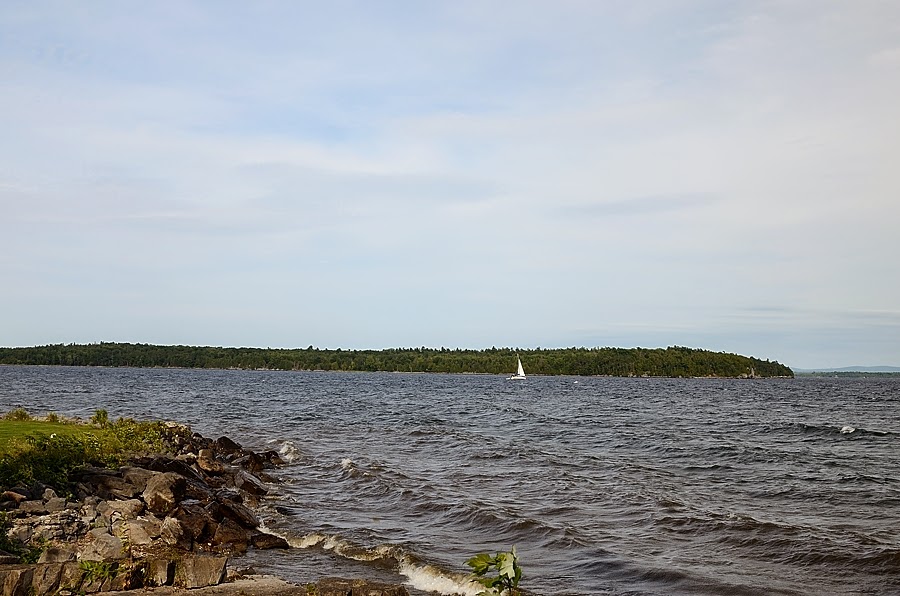
It is easy to see Valcour Island from the boat launch at Peru, New York, and from the campus of Clinton County Community College at Bluff's Point, but not from the vicinity of the New York State Marker along Route 9 that purports to identify the area of the action.  There is a conference center there (private property).  One wold think that such an important battle would not only not be so generally ignored in discussions of the war for the lay person, but would also have a small dedicated parking and viewing area by the roadside.

Anyway, here's a view of the strait near the sign that shows the vicinity of the battle.


There are those who credit Benedict Arnold with creating and commanding America's first navy.  It was here, in the straight between the New York mainland (shown in foreground) and Valcour Island (showing the island to its southern tip) that, on October 11, 1776, Arnold stopped the pursuit of Guy Carleton, commander-in-chief of the British forces in Canada, following Arnold's withdrawal from the siege of Quebec in spring 1776.

The only other plaque I found apart from the one by Route 9 was at Bluff's Point.  We should always recall the words of George Santayana that "Those who cannot remember the past are condemned to repeat it," although Edmund Burke far more contemporaneous to the Revolution, also reportedly said, “Those who don't know history are doomed to repeat it.” The war might well have been crushed before it began but for Arnold's determined and heroic stand in these waters, yet you could not tell it from the minimal coverage here. 

Friday, April 18, 2014

Lexington

Tomorrow, April 19, marks the anniversary of the "battle" of Lexington.  This was less a battle than an unintentional skirmish that grew into the battle of Concord.  Nonetheless, we grow up learning about the "Battle of Lexington and Concord."

Visitors to Lexington can observe markers showing the line formed by Captain John Parker and his 70 or so militiamen:


No one today knows who fired the first shot.  At the time, the Americans blamed the British and the British blamed the Americans.  The voice of American minuteman Sylvanus Wood, 23 reaches across the centuries: "[t]he British troops approached us rapidly in platoons, with a General officer on horse-back at their head.  The officer came up to within about two rods of the centre of the company, where I stood.--The first platoon being about three rods distant.  They there halted.  The officer then swung his sword, and said, 'Lay down your arms, you damn'd rebels, or you are all dead men--fire.' Some guns were fired by the British at us from the first platoon, but no person was killed or hurt, being probably charged only with powder.  Just at this time, Captain Parker ordered every man to take care of himself.  The company immediately dispersed; and while the company was dispersing and leaping over the wall, the second platoon of the British fired, and killed some of our men.  There was not a gun fired by any of Captain Parker's company within my knowledge."


British Lieutenant John Barker, also present, disagreed: "At 5 o’clock we arrived there and saw a number of people, I believe 2 and 3 hundred, formed on a common in the middle of the town; we still continued advancing, keeping prepared against an attack tho’ without intending to attack them, but on our coming near them they fired on or two shots, upon which our men without any orders rushed in upon them, fired and put ‘em to flight; several of them were killed, we could not tell how many because they were got behind walls and into the woods; We had a man of the 10th Light Infantry wounded, nobody else hurt. We then formed upon the common but with some difficulty, the men were so wild they could hear no orders; we waited a considerable time there and at length proceeded on our way to Concord, which we then learnt was our destination, in order to destroy a magazine of stores collected there."

     Voices from the past speak to us from the Green on this anniversary.

Sunday, February 23, 2014

Fort Billings

Three forts were part of a  matrix of defenses to protect Philadelphia and control the Delaware River.  Forts Mifflin and Mercer were just south of Philadelphia on both the Pennsylvania and New Jersey sides of the river.  The third, Fort Billingsport, was a few miles to the south.   General Thaddeus Kosciuszko was involved in the work on Fort Billingsport, his first engineering assignment authorized by the Continental Congress, but the full construction was never completed.


The British held Philadelphia following the American loss at Brandywine.  Seeking to free the river so that supplies could be transported to Philadelphia, occupied by the British on September 23, 1777, General Howe ordered assaults on the American positions.  Washington deemed the forts critical enough to urge they be held “to the last extremity.” On October 2, 1777, the 112 man garrison was evacuated, and the British took the fort.

What is significant is that it was a strategic move led by two of the early American marine officers, Dennis Leary and William Barney, memorialized by a plaque on this site.  Ultimately, both Forts Mifflin and Mercer fell, as did Philadelphia, but it did not mark the end of civilization. let alone the war, some were projecting. 


Friday, November 22, 2013

Ninety-Six and the Nuclear Option

Ninety-Six was the site of a siege and battle in November 19–21, 1775 between Patriot and Loyalist forces, resulting in a stalemate.  Here is a view of the road that was in place at the time around the village of Ninety-Six.


Six years later, from May 22 through June 18, 1781, it would be the scene of an attempt by American General Nathanael Greene to take the fort, held by Loyalist forces under Lieutenant Colonel John Cruger. In 1775, though, it was another exchange between Patriots and Loyalists reflecting the bitter internecine warfare to come in South Carolina.

This month the press has been full of stories on the so-called "nuclear option" in the Senate that abolished filibuster in most instances, and what it means for the way the country does business. While we do not seem, yet, to have reached the levels of violence that marked the onset of the Revolution, the depth of feeling, if not outright loathing, that partisans currently feel towards each other seems to draw roots reaching back over two centuries.  It may not be long before we revert to tarring and feathering.

Saturday, October 12, 2013

Boston, Dorchester Heights and Geography

On an extended business trip to Boston last week, I had occasion to take in the view from the top of the Prudential Tower.  Here is a view of Boston today, looking seaward, with Dorchester Heights just visible next to the tall building toward the right of the image, jutting into the water.  The small white monument just to the left of that building is at the top of the Heights.


It is hard to appreciate the strategic importance today, perhaps, in looking at the built-up nature of the city.  Nonetheless, we see a view that neither Washington nor Howe could see in assessing their options.

Sunday, May 12, 2013

The Crooked Billet

     The Battle of Crooked Billet on May 1, 1778 (now in present-day Hatboro, Pennsylvania), was one of the more extended skirmishes arising out of the competition for forage and supplies between British and American forces.  A monument on the grounds of a school commemorates the battle.


     Washington's preferred commander of Pennsylvania militia, General James Potter, was on leave, so General John Lacy was charged with patrol and prevention of British seizure of American supplies, in command of about 400 men.  Major John Simcoe, in command of the Queen's Rangers, and Colonel Robert Abercromby, led about 850 men in a dawn attack on May 1, overwhelmed the initial force, chased them for miles and emerged victorious.  Allegations of British brutality against prisoners led Washington to appoint General William Maxwell to investigate.

     Something else worth nothing about Crooked Billet is the fact that while the soldiers of the Continental Army were starving and freezing, and these foraging raids and skirmishes were occurring, Congress was setting the rates for wagons and supplies.  The American commissary and quartermaster functions were in complete disarray.  Americans were selling to the British because that was what the market would bear.  It wasn't all patriotic fervor in America.


Sunday, August 12, 2012

The End of the Revolutionary War

There seems to be some disagreement over the actual last land battle of the Revolutionary War.  Contrary to what many lay people seem to believe, hostilities did not end at Yorktown in October 1781.  Howard Peckham's invaluable The Toll of Independence notes dozens of engagements in 1782, resulting in 277 American deaths,  124 wounded, with 80 captured; he lists only 5 land engagements for 1783.  Among the final actions, the Battle of Cedar Creek Bridge in Stafford Township, New Jersey, is his last listed for 1782 and among the six final "engagements" of the war.  Here we see a view of the area, with the Cedar Bridge Tavern (now a private residence) glimpsed to the left and the creek at the bend in the road in the center of the picture.
The engagement occurred on December 27, 1782, when local militia under Captains Richard Shreve and Edward Thomas sought out the hated Loyalist, Captain John Bacon.  They and their men stopped at the tavern, were surprised themselves by Bacon and his forces, and when they were gaining the upper hand, Bacon was supported by fresh Loyalists, which facilitated Bacon's escape.  The Patriots lost 1 killed and 1 wounded; 1 Loyalist was killed, 4 wounded, and 7 taken prisoner.  Shreve's militia did manage to kill Bacon on April 3, 1783, Peckham notes, after the peace treaty was signed.  The Stafford Township Historical Society lists this as the "last battle" of the war.

Whether it owns that distinction or not of being "last," the place remains sacred: at least one man on each side of the civil war divide lost his life here.  While the bitterness of the internecine nature of this war is often discussed in the context of the Carolinas, here in "southern" Jersey, the divide was often just as broad and brutal.


Sunday, April 15, 2012

The Omnipresent Henry Lee

The Battle of Paulus Hook was a daring raid on the British fort at Paulus Hook (now in Jersey City) across from Manhattan.  It was proposed by then Major Henry ("Light Horse Harry") Lee following the success of the Americans at Stony Point.  Following a night time expedition, on August 19, 1779 Lee, with 400 men, surprised the British, took some 150 prisoners, and then beat a retreat.  Washington wrote Congress that Lee "displayed a remarkable degree of prudence, address and bravery upon this occasion, which does the highest honor to himself and to all the officers and men under his command.

This is a view of the spot of the fort today:

This is at the intersection of Washington Street and Grand Street in Jersey City, looking towards New York.  Landfill and the development of the area, coupled with the construction of the Morris Canal nearby, makes it hard to get a real sense of terrain, as one does at Stony Point.  Nonetheless, the obelisk visible in the photograph helps orient us.  Lee received a Congressional gold medal for his efforts.  Though perhaps more well  known generally for his service in the Southern Theater of the Revolutionary War, this officer was one of those keystones of Washington's command.  It is interesting to walk in his steps, even if the ditches, mills, streams and swamps, and indeed the actual coastline, have been altered.